The finest outdoor environments feel effortless.
Every surface, edge, and accent feels like it belongs exactly where it is, as if the space grew from the ground with intention rather than appearing overnight courtesy of a contractor’s standard package.
That quality, or the sense that a space was truly conceived rather than assembled, is the product of deliberate hardscaping decisions made early in the design process. Most patios fail to achieve it, not because the materials are wrong, but because no one treated material selection as a design language. Stone gets laid. Tile gets set. A few planters show up. The result functions, but it doesn’t say anything.
Custom hardscaping changes that equation. When natural stone, large-format porcelain, decorative tile accents, and architectural metalwork are selected and combined with a coherent design logic, the outdoor space becomes something else entirely: a composition with a point of view.
This article covers the materials shaping luxury patio designs right now, the principles behind mixing them successfully, and why in-house metal fabrication capability is the differentiator most homeowners don’t know to ask about until they see what it produces.
The Surface Beneath Everything: Why Material Choice Defines a Space
Before a single plant is placed or a light fixture is chosen, the hardscape establishes the visual and tactile experience of an outdoor space. The floor plan outdoors carries the same design weight as any interior flooring decision, and in many ways it carries more: it has to perform across temperature extremes, handle water, and hold its character through years of Arizona sun.
Material choice shapes perceived scale. Large-format pavers with tight joints make a modest patio feel expansive. Smaller, irregular stone creates intimacy. Color temperature affects how a space reads at midday versus at dusk, and how it relates to the home’s exterior palette.
There is also the matter of thermal comfort, a non-negotiable consideration in desert climates. Certain materials absorb and radiate heat; others reflect it. That distinction affects how a patio is actually used through the summer months, which means it belongs in the design conversation from the start, not as an afterthought to aesthetics.
The most successful outdoor landscape design projects treat the hardscape as a design language: a consistent thread of materials that connects patio, pool deck, walkways, retaining walls, and entry zones into a coherent whole. At Creative Environments, landscape architects select materials in tandem with the full site plan, ensuring every surface decision reinforces the spatial narrative rather than competing with it.
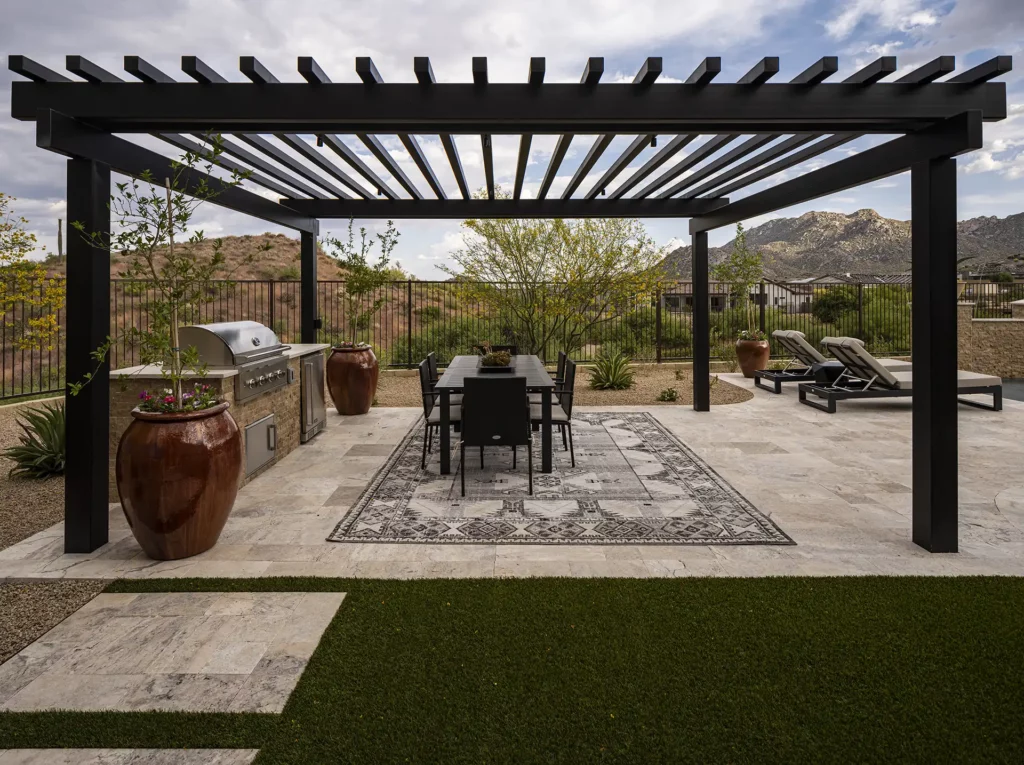
Stone, Porcelain, and Deco Tile: Building a Luxury Patio Palette
The materials available for custom hardscaping have never been more varied or more refined. Four categories are defining luxury patio designs in Arizona right now, each with distinct properties and a specific role to play in a well-composed outdoor space.
Travertine: Timeless, Thermal, and Perfectly Arizona
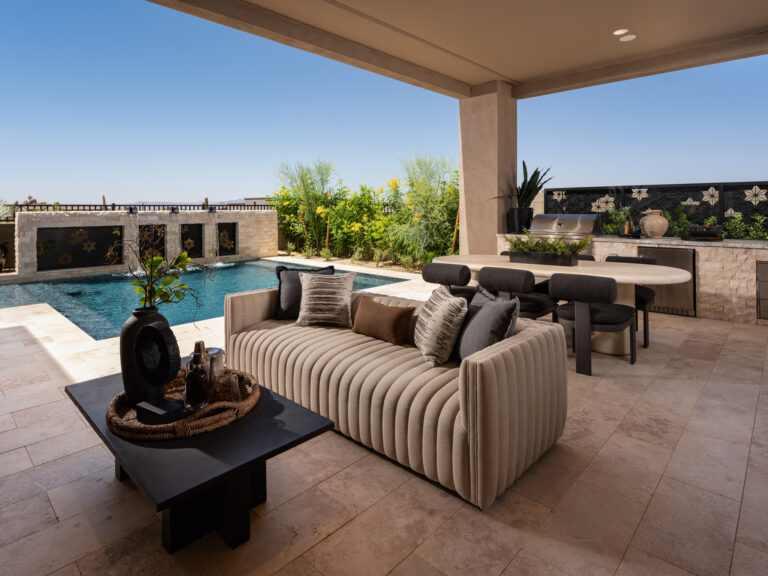
Natural travertine remains one of the most trusted materials in desert landscape design services, and for good reason. Its warm ivory-to-walnut tonal range complements both traditional and contemporary architecture, and its naturally porous surface stays cooler underfoot than dense porcelain or concrete in direct sun.
Travertine is available in a range of finishes: tumbled and aged surfaces for an organic, old-world quality; honed and filled for a cleaner, more refined look. Each option reads differently at scale. Tumbled travertine on a winding garden path creates texture and movement. Honed travertine in a large-format slab laid around a pool deck reads with the crispness of a resort property.
For pool surrounds, covered patios, and entry courts, travertine offers a combination of beauty and practical durability that few materials match in this climate.
Large-Format Porcelain: The Indoor-Outdoor Blur
No material trend has reshaped luxury patio design more significantly in the past decade than large-format porcelain. Slabs in 24″x48″ and 36″x36″ formats reduce or eliminate visible grout lines, creating a continuous surface plane that reads as a single, unbroken field.
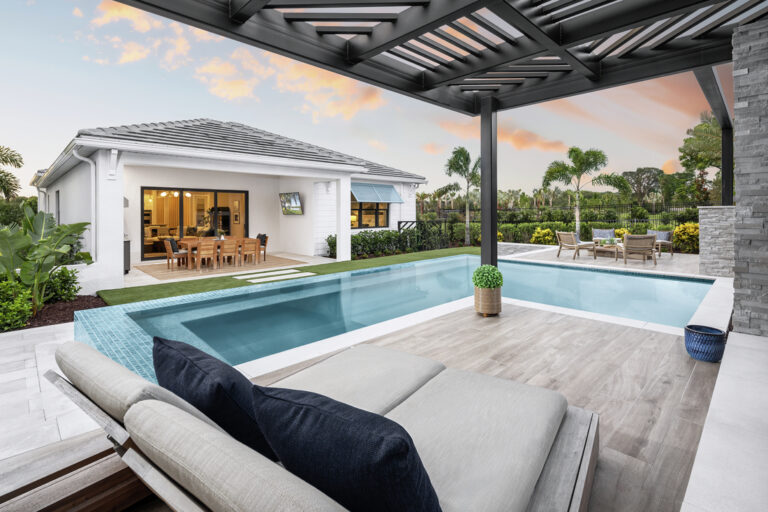
The design impact of this is substantial. When interior flooring and exterior paving share the same porcelain species, laid in the same direction with aligned grout joints, the boundary between inside and outside dissolves. A glass wall slides open, and the floor simply continues. This is the indoor-outdoor continuity that architect-referred clients and design-forward homeowners are specifying in increasing numbers.
Beyond aesthetics, large-format porcelain brings genuine performance advantages. It is frost-proof, stain-resistant, impervious to UV-driven color shift, and requires minimal maintenance. In Arizona’s climate, those properties matter year after year.
Decorative Tile: Pattern as Punctuation
Decorative tile works best as an accent rather than a field material. A Moroccan-patterned insert at the center of a travertine courtyard, a geometric porcelain border banding the edge of a pool deck, hand-painted tile on stair risers: these applications use pattern the way a designer uses a contrasting pillow or a piece of art. They mark transitions, define zones, and introduce visual interest without overwhelming the composition.
Current trends in luxury Arizona projects favor bold geometric patterns, cement tile looks in porcelain bodies for durability, and Mediterranean-influenced deco patterns that complement desert-toned natural stone. The key design principle is restraint: deco tile placed at one or two focal points does more work than deco tile used everywhere.
Natural Stone: Flagstone, Quartzite, and the Handpicked Advantage
Beyond travertine, natural stone in the form of irregular flagstone and quartzite plays a distinct role in outdoor landscape design. Flagstone in organic, irregular cuts creates estate-style compositions that feel grown rather than installed. Quartzite, with its tight grain and durability, excels as coping material on water features, as a cap on retaining walls, and as a rugged accent surface.
The distinction between stone sourced thoughtfully and stone pulled from a standard supplier yard is visible at a distance. At Creative Environments, material is hand-selected to ensure color harmony across the full project: a quartzite wall cap that reads warm gold in isolation can clash with a cool grey travertine deck if no one put them side by side before installation.
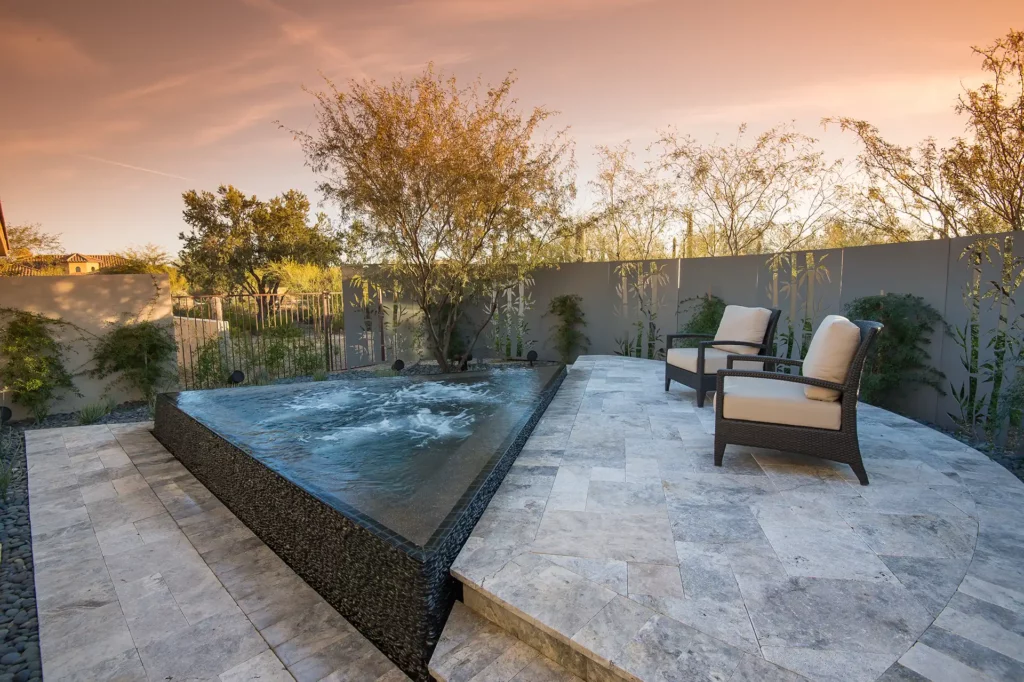
When Materials Converge: The Logic Behind Mixed-Surface Luxury Patio Designs
Mixing materials is where most contractor-level projects go wrong, and where professional landscape design proves its value. The instinct to mix is correct; the execution is what separates a composed outdoor space from one that looks like it was built in phases by different people who never spoke to each other.
Three principles govern successful material mixing in custom hardscaping:
Scale Harmony
Materials with similar visual weight coexist easily. A large-format porcelain field reads at the same scale as a wide-plank travertine border. Introducing a small-scale mosaic into the same composition creates visual tension unless it is contained within a clearly defined inset or frame.
Tonal Consistency
Materials do not have to match, but they must be in conversation. Warm-toned travertine and cool grey porcelain can coexist on the same patio when a third element, a grout color, a metal accent, or a planting tone, bridges the gap between them.
Purposeful Contrast
The most visually compelling hardscapes use contrast with intent. A field of smooth, large-format porcelain reads more powerfully next to a coursed stone retaining wall. The rough texture of stacked natural stone becomes a feature precisely because the surrounding surfaces are refined.
Consider a composition that integrates all of these principles: a large-format porcelain field running from the interior living space to the exterior patio without a threshold break; a border of honed travertine framing the transition to a pool deck; hand-painted deco tile on the stair risers between levels; and corten steel planter edges defining the planted zones at the perimeter. Each material has a role. No surface is redundant. The result is a space where a first-time visitor can feel the design logic without being able to name it.
Realizing this kind of composition requires visualization tools that go beyond material samples on a table. Creative Environments’ 3D rendering process allows clients to see how multi-material combinations read at full scale, in the actual light conditions of their site, before a single piece is cut or ordered.
The Finishing Argument: Why Custom Metalwork Completes a Hardscape
Most landscape design services stop at stone and tile. Creative Environments does not, and the difference in the finished product is difficult to overstate.
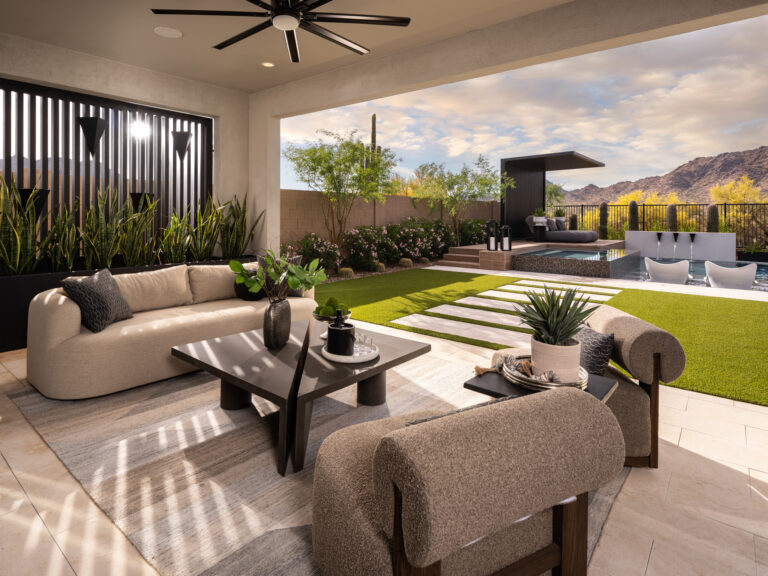
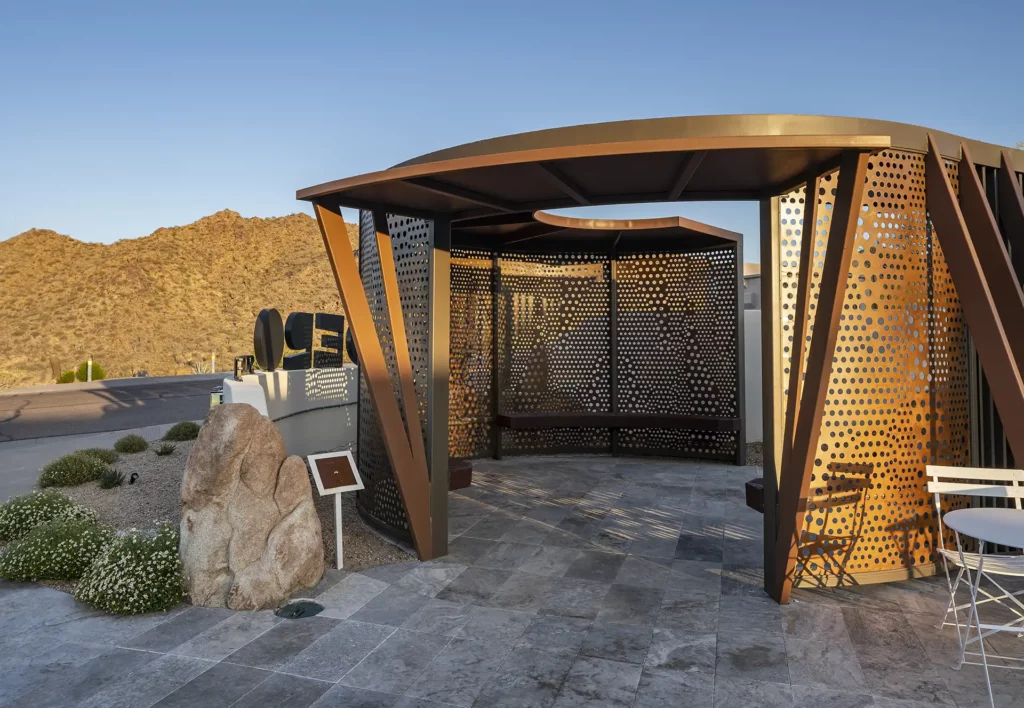
An in-house metal fabrication shop is an unusual capability for an outdoor landscape design firm. It is also the capability that produces some of the most distinctive elements in the portfolio: the geometric steel pergola that frames a view without blocking it; the laser-cut privacy screen that casts patterned shadow across a travertine patio at midday; the corten steel raised planter that anchors a corner of the garden with the weight and warmth of rusted iron against pale stone.
Metal in an outdoor composition functions as architecture, not decoration. It defines edges. It creates enclosure and threshold. It controls sightlines and manages scale. A custom gate or railing at a level change is not just a safety element; it is a line drawing rendered in steel, visible from inside the home and from the street.
The materials in Creative Environments’ fabrication work each carry distinct design properties:
Corten steel develops a rich rust patina over time that deepens in color with weathering. In desert settings, it pairs with travertine and warm stone in a way that feels native to the landscape. Raised planters, retaining wall caps, and fire feature surrounds in corten steel age into the design rather than away from it.
Powder-coated steel delivers clean, precise geometry in any color, with a finish that holds in Arizona’s UV conditions. It is the material of choice for pergola frames, privacy screens, and gates where the design calls for sharp lines and color-matched integration with the home’s architecture.
Laser-cut architectural panels bring the visual logic of decorative tile up to an architectural scale. A patterned metal screen introduces texture, light play, and visual depth to a flat wall surface or a shade structure. The pattern can be designed to reference other elements in the space, creating a design thread that runs from the floor through the vertical plane.
The integration advantage is specific to Creative Environments’ design/build model. The metal fabrication team works alongside the landscape architects and hardscape crew from the design phase forward. Every bracket, planter edge, pergola post base, and structural accent is drawn to align with the hardscape plan, not sourced from a catalog after the stone is set. This is the difference between metalwork that completes a space and metalwork that crowds it.
Bringing the Inside Out: Large-Format Pavers and the Seamless Threshold
The single most requested outcome in luxury outdoor landscape design right now is the disappearing threshold: the point where interior and exterior meet with no visible interruption. Glass doors fold back into the wall. The floor continues. The inside and outside become one room.
Achieving this outcome is a coordination problem as much as a materials problem. Large-format porcelain is the enabling material, but the execution depends on subbase preparation, drainage slope management, expansion joint placement that doesn’t disrupt the visual field, and alignment between the interior floor tile and the exterior paving from the outset of the project.
In Arizona’s climate, thermal movement is a design consideration that cannot be ignored. Porcelain and stone expand and contract with temperature swings that reach 50 degrees or more between morning and afternoon in summer. Material selection, joint sizing, and installation method all need to account for this, or the clean floor plane that looked flawless at installation will telegraph stress cracks within a few seasons.
This is precisely why Creative Environments’ design/build integration model matters for this kind of outcome. The landscape architect, the hardscape crew, and the architectural plans for the home are coordinated before a single paver is set. The interior tile species, the exterior material, and the threshold detail are resolved as a system, not as separate scopes that meet at the door frame.
Frequently Asked Questions About Custom Hardscaping and Luxury Patio Materials
What is the best material for a luxury patio in Arizona?
There is no single answer, and any landscape design service that leads with one will produce a generic result. For classic desert estates, travertine offers heat-reflective properties, timeless character, and durability that holds up across decades. For contemporary homes targeting indoor-outdoor continuity, large-format porcelain delivers a clean, low-maintenance surface with color stability in extreme UV. Most of the best projects in the Creative Environments portfolio use both, along with accent materials that introduce pattern and texture at specific points in the composition.
How does custom metalwork fit into a hardscape design?
Think of metalwork as the architectural layer of the outdoor composition. Stone and tile define the horizontal plane. Metal defines the vertical: the edges, the enclosures, the sightlines, the transitions between spaces. Custom fabricated pergola frames, privacy screens, planters, gates, and railings give a hardscape its three-dimensional character. Because Creative Environments fabricates metalwork in-house, it can be designed to integrate with the hardscape plan from the beginning rather than being specified separately and installed as an afterthought.
Can I mix different patio materials without it looking inconsistent?
Yes, with the right design logic governing the combination. Tonal harmony, scale balance, and purposeful contrast are the three controls. Materials do not need to match; they need to be in a coherent relationship with each other. The Creative Environments 3D rendering process gives clients the ability to evaluate material combinations at full scale before installation begins, which eliminates the guesswork and makes the final outcome predictable.
How much does custom hardscaping cost in Arizona?
The range is wide because custom hardscaping scales with material selection, site complexity, and scope. What matters more than a starting number is the design process: a project that has been properly specified before installation begins holds to its budget. Creative Environments’ design/build model includes full 3D rendering and material coordination at the design stage, so scope, material costs, and installation requirements are defined before work starts. The consultation is where that conversation begins.
Your Outdoor Space Should Have a Point of View
A patio serves a function. A great patio makes a statement. The difference between the two is not budget, and it is not scale. It is whether someone made deliberate decisions about materials, composition, transitions, and the relationship between surface and structure before the first piece was set.
Natural travertine, large-format porcelain, decorative tile accents, and custom fabricated metalwork each bring something specific to an outdoor composition. Used together with design logic, they produce spaces that feel authored: spaces where every detail is connected to every other detail, and where the whole is clearly greater than the sum of its parts.
Creative Environments has been building outdoor spaces at this level across Arizona for over 75 years. The portfolio spans luxury residential estates, resort properties, and high-end commercial developments, all produced through a design/build model that keeps architecture, hardscape, and fabrication coordinated under one team from first concept to final installation.
The gallery is the best place to see what this looks like in practice. The consultation is where it starts for your property.