There is a quiet conversation happening in backyards across the Valley right now.
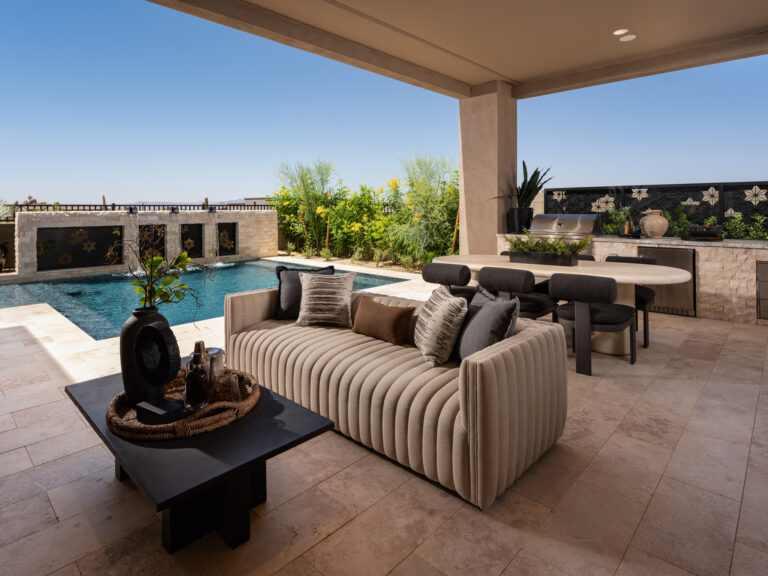
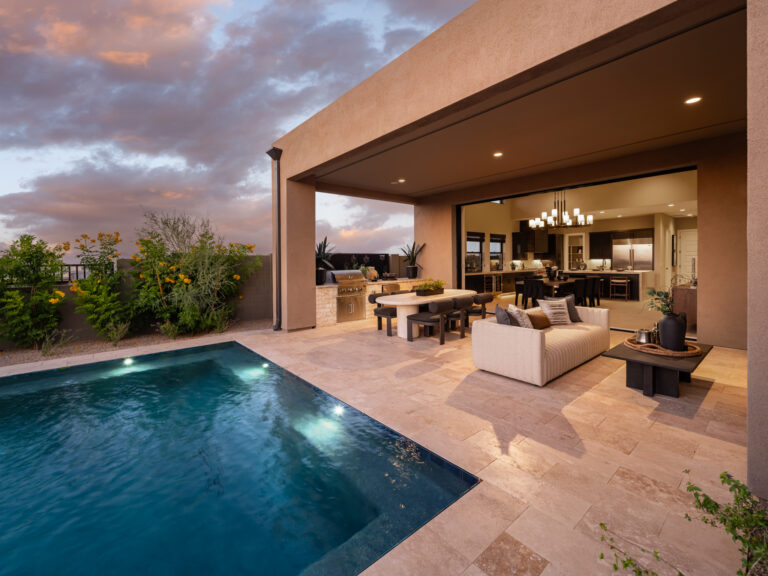
On one side sits the dream. A shaded dining terrace. Water moving over stone at dusk. A garden that makes the house look like it belongs to the desert rather than sitting on top of it.
On the other side sits reality. Rising water costs. Longer, hotter summers. A growing sense that a beautiful yard should not be a wasteful one.
For years, those two ideas felt like opposites. Choosing responsibly meant accepting less. Less green, less water, less presence.
That trade has quietly disappeared.
The most striking Arizona landscaping being built today uses far less water than the yards it replaced. Not through subtraction, but through better engineering. Sustainable luxury is what happens when restraint becomes a design discipline instead of a compromise.
Here are the five systems doing that work.
Why Sustainable Luxury Has Become the Most Requested Style in Arizona Landscape Design
Something shifted in the last few years. Homeowners stopped asking whether a low-water yard could look expensive, and then started asking how soon it could be built.
Three forces are behind that change.
- The first is cost. Water is priced to reflect scarcity across the Phoenix metro, and a thirsty landscape shows up on the bill every single month.
- The second is climate. Summers now test every plant, pump, and paving material in the yard. Designs built on imported ideas simply fail here.
- The third is taste. There is a new confidence in the desert as a design language. Sculptural plants, warm stone, deep shade, and restrained water all read as intentional now. Gravel and green lawn read as dated.
The important part is this. Sustainability in landscape design in Arizona is not a plant list. It is a set of systems working together beneath the surface. Get those right and the finished space feels generous rather than careful.
1. Native and Drought-Tolerant Plants That Still Look Designed
Say “desert landscaping” and most people picture the same thing. A field of gravel. Three agaves spaced too far apart. A boulder that nobody knows what to do with.
That is not a design. That is an absence of one.
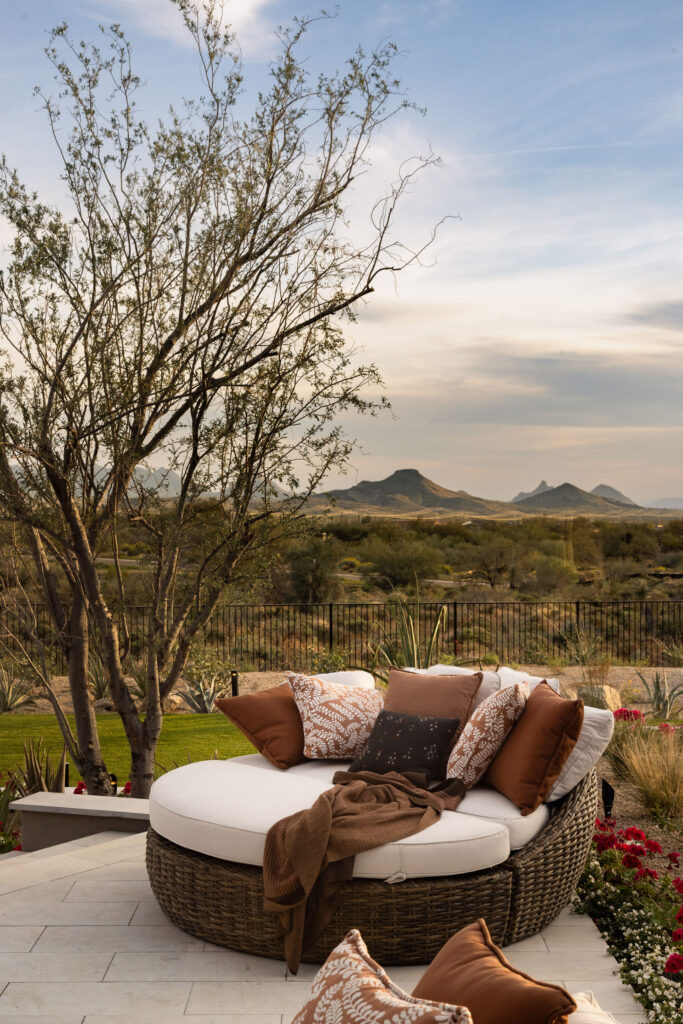
A serious drought-tolerant garden is built in layers, the same way a room is furnished.
Canopy
Multi-trunk desert trees create the shade that makes everything below them possible. Palo brea and hybrid palo verde bring filtered light and beautiful branch structure.
Mid-height structure
Hopseed, Texas sage, and native shrubs give the garden its walls and its privacy.
Groundcover and texture
Low spreading plants soften edges and cover soil, which keeps root zones cooler and reduces water loss.
Sculpture
One specimen ocotillo or a mature fence post cactus does more for a courtyard than a dozen small plants ever will.
Placement is where the money shows. A large, well-chosen specimen set exactly where the evening light hits it becomes the focal point of the entire yard. This is also the heart of true low-maintenance landscaping. Plants suited to this climate are not fighting to survive here, so they need less water, less pruning, and far less replacing.
2. Smart Drip Irrigation That Removes the Guesswork
Most water in an Arizona landscape is not used. It is lost.
Lost to broken emitters nobody noticed. Lost to a timer still running its March schedule in August. Lost to a single valve watering a citrus tree and a barrel cactus on the same cycle.
Smart irrigation fixes all three, and it does it invisibly.
Zoning by water need
Plants get grouped by how much water they actually want, not by where they happen to sit in the yard. This one decision does more for efficiency than any device.
Weather-based control
A smart controller adjusts to local conditions and skips cycles the yard does not need. After a monsoon storm, the system simply stands down.
Sensors and flow monitoring
Soil moisture readings and flow alerts catch a leak in hours instead of at the end of the billing cycle.
Precision delivery
Drip and inline tubing put water at the root zone, where evaporation cannot take it first.
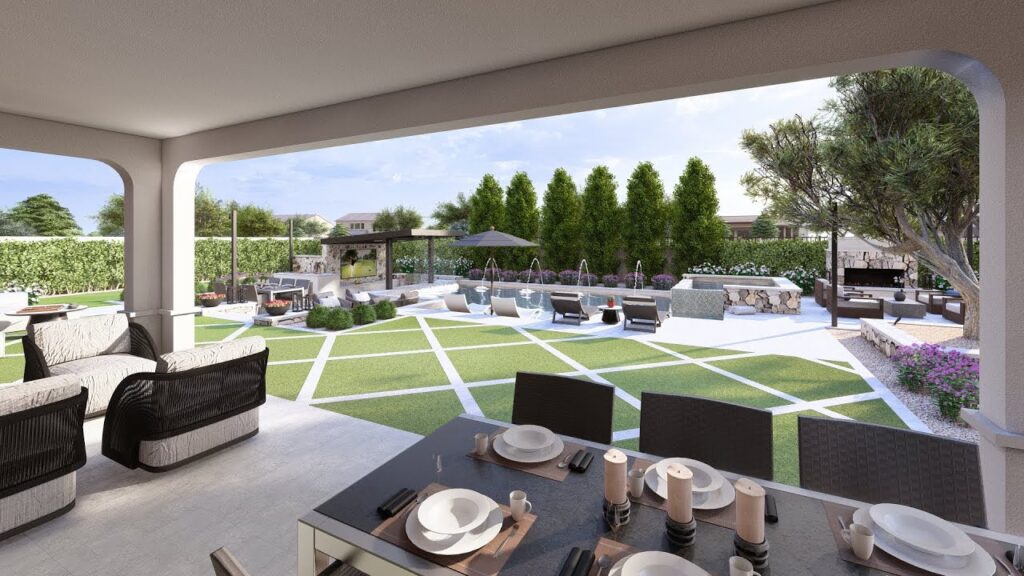
None of this is visible in the finished landscape, which is exactly the point. Thoughtful eco-friendly irrigation and lighting does its work quietly, underground, while you enjoy the part above it.
3. Solar and Low-Voltage Lighting That Gives You the Evening Back
Here is something visitors to Arizona never quite grasp. For much of the year, the yard belongs to the evening.
Which means lighting is not decoration. It is the difference between a space you look at and a space you live in.
The best plans use two tools together.
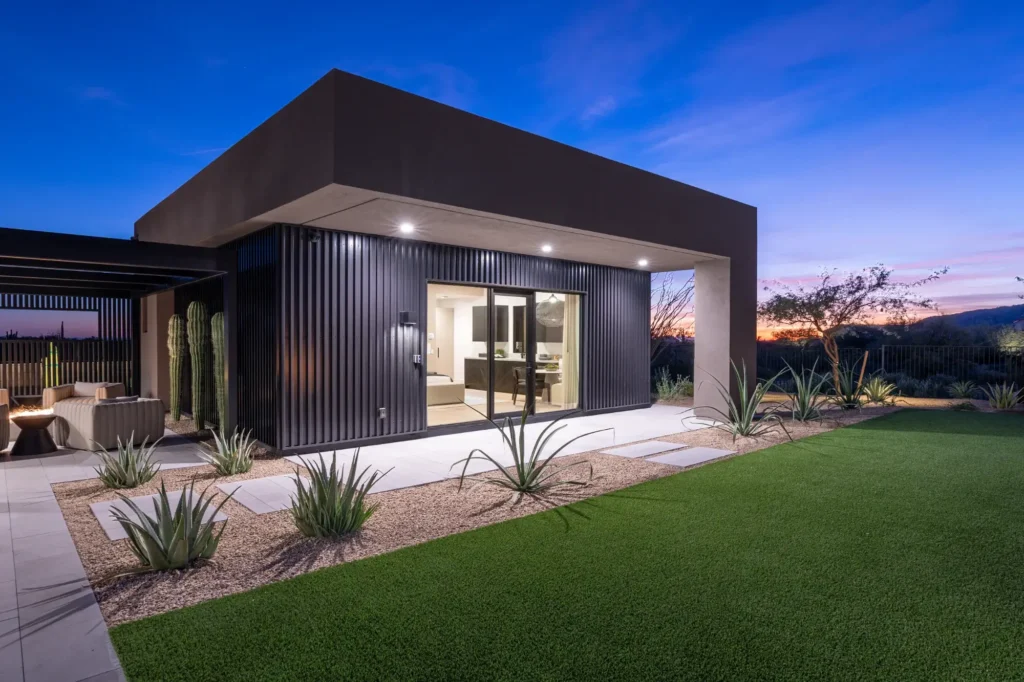
Solar handles the places where trenching makes little sense. Path lights along a decomposed granite walk. Accents deep in a garden bed. Markers along a perimeter wall. No wiring, no draw on the house.
Low-voltage LED handles the moments that need real performance. Uplighting a specimen tree so its branch structure reads against the night sky. Grazing light across a stone wall to bring out its texture. Warm illumination inside a pool or water feature.
Two details separate a refined lighting plan from a bright one. Warm color temperature, which keeps the desert palette looking rich instead of clinical. And shielded fixtures aimed down, which respect the night sky and keep glare out of your neighbor’s bedroom window.
LEDs also run cool and last for years. Fewer service visits, less waste, better light.
4. Water-Wise Pool and Water Feature Design
The question comes up in almost every consultation. Can a pool belong in a sustainable landscape?
It can, and the reasoning is more interesting than most people expect.
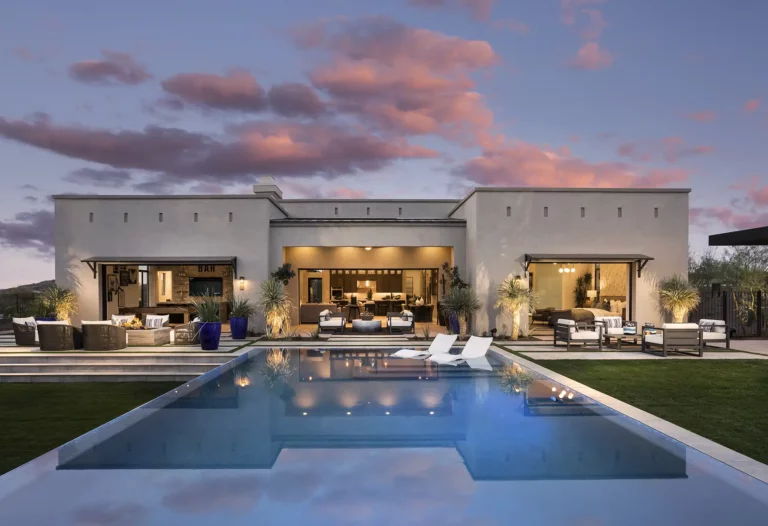
A pool does not lose meaningful water when you fill it. It loses water to evaporation, every day, for decades. So a water-wise pool is really an evaporation problem solved through design.
Right-sized surface area
A pool shaped for how you actually swim, rather than to fill a lot line, loses less to the air.
Wind protection
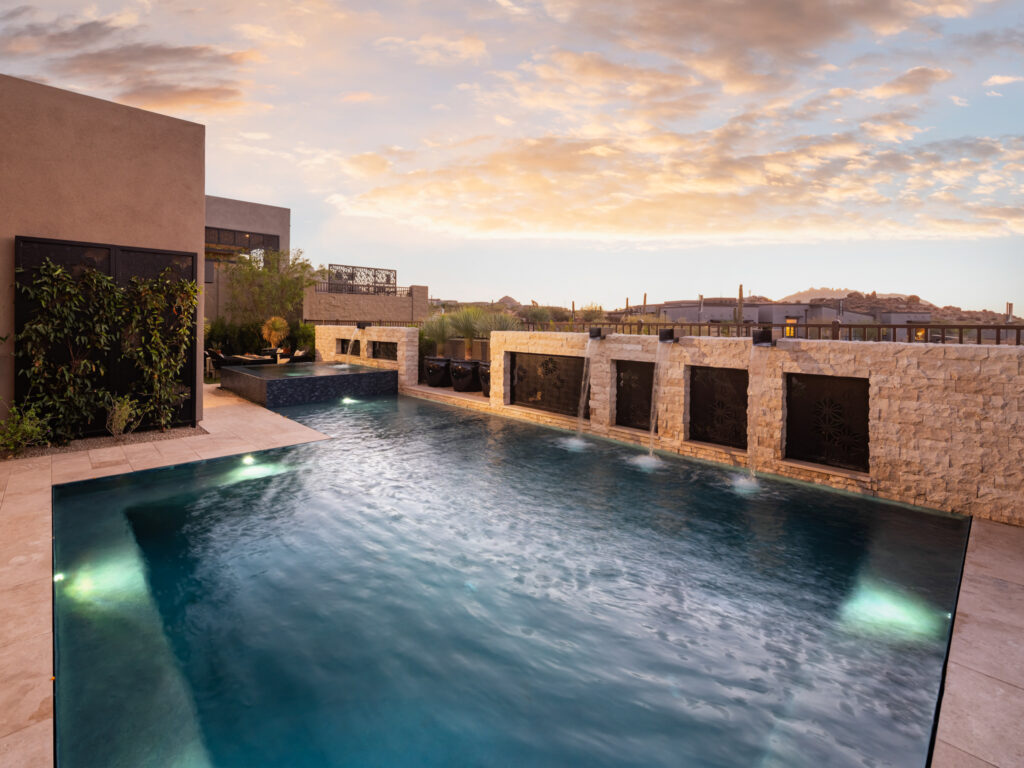
Moving air accelerates evaporation. Screen walls, planting, and shade structures cut that loss significantly.
Automatic covers
The single most effective tool available, working every night while nobody is watching.
Shade over shallow water
Tanning ledges and shelves heat fastest. Shading them keeps water temperature and evaporation down.
Efficient equipment
Variable-speed pumps use a fraction of the energy of older single-speed units, run far quieter, and support better water care with less product.
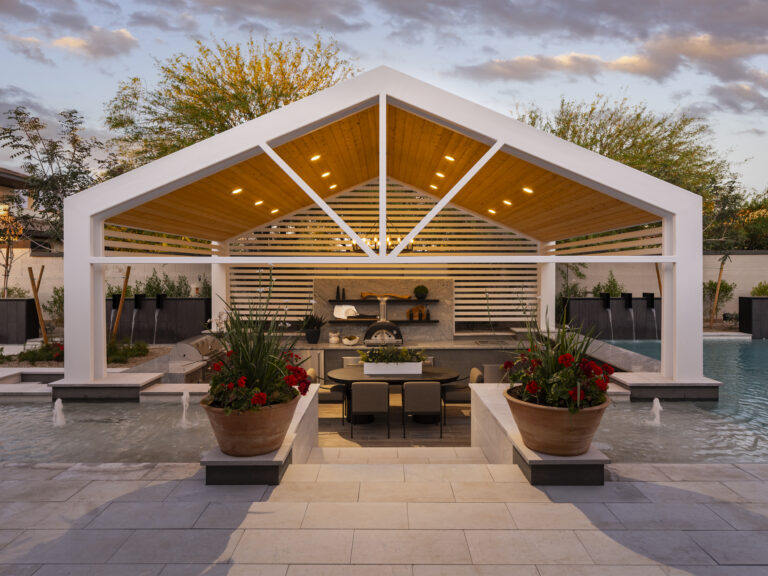
Water features follow the same logic. A basalt column or a sheer descent circulates the same water in a closed loop. It reads as abundance and behaves like restraint. That is the whole idea of sustainable luxury in one detail, and it is why custom pools and spas and the landscape around them should always be designed together.
5. Permeable Hardscape Built for the Monsoon
Arizona gets very little rain. When it does arrive, it arrives all at once.
Traditional paving treats that water as a nuisance to be pushed toward the street. Permeable hardscape treats it as an asset.
Open-joint pavers, stabilized decomposed granite, and stone set over aggregate all let storm water pass through the surface and soak into the ground below. Less runoff. Less erosion. Less standing water against your foundation.
Grading works alongside it. Gentle basins and swales can route runoff from a roof or patio directly into planting beds, so a summer storm quietly irrigates the garden for free.
There is a comfort benefit too. Lighter finishes and shaded surfaces hold far less heat than dark concrete, which is the difference between a patio you use in July and one you avoid.
Permeable systems are not right everywhere. Heavy vehicle loads, certain soil conditions, and steeper slopes all call for different solutions. That is a judgment call for the design phase, and it is why custom hardscaping should be planned with drainage in mind from the very first sketch.
What Sustainable Luxury Costs, and What It Gives Back
Let us be straightforward about the money.
Some of this costs more up front. Smart controllers, permeable systems, and specimen native plants carry a premium over a conventional build. Anyone who tells you otherwise is selling something.
The return arrives in four places.
Your water use drops. Your pool equipment draws less power. Your plants stop dying and needing replacement every few seasons. And your maintenance hours fall, because a landscape suited to this climate is not in a constant fight with it.
And when the house eventually goes on the market, buyers here now ask what the landscape costs to run. Having a good answer matters.
Designing Your Own Sustainable Luxury Landscape
These five systems are strongest together. Beautiful native planting on an unzoned irrigation system still wastes water. A permeable patio with harsh lighting still sits empty at night. The result comes from the whole design, not one element of it.
Creative Environments has been designing and building outdoor spaces in Arizona since 1950, from our home in Tempe. Design, pools, hardscape, metal fabrication, and maintenance all live under one roof, which means the plant palette, the irrigation, the lighting, and the stone are drawn by one team that understands how they affect each other.
More than 200 national and regional awards later, that approach still holds. We serve Tempe, Scottsdale, Paradise Valley, Chandler, Gilbert, Phoenix, Ahwatukee, Queen Creek, and communities throughout the Valley.
Ready to see what your space could become? Book a design consultation or spend a few minutes in our Signature Collections gallery first.
Frequently Asked Questions About Arizona Landscaping
Does sustainable landscaping in Arizona mean giving up a green yard?
No. It means choosing green that belongs here. Native and adapted plants deliver real depth, color, and shade while using a fraction of the water a traditional lawn demands.
How much water can smart drip irrigation actually save?
Savings depend on what the system replaces, and the gains are usually substantial. The largest wins come from grouping plants by water need and from controllers that respond to real conditions rather than a fixed schedule.
Are solar landscape lights bright enough for a luxury property?
Solar works beautifully for paths, garden accents, and perimeter markers. For uplighting trees, washing stone, and illuminating water, low-voltage LED still gives you the control and output a high-end design needs. Most of our plans use both.
Do permeable pavers hold up to Arizona heat and monsoon storms?
Yes, when the base is built correctly. A properly engineered permeable system handles heavy storm flow and extreme heat well. Base preparation and material selection are what determine long-term performance.
Is a pool responsible during a drought?
It can be, when it is designed for this climate. Right-sized surface area, wind protection, an automatic cover, and efficient equipment reduce loss dramatically. A well-designed pool can use less water over a year than the lawn it replaced.