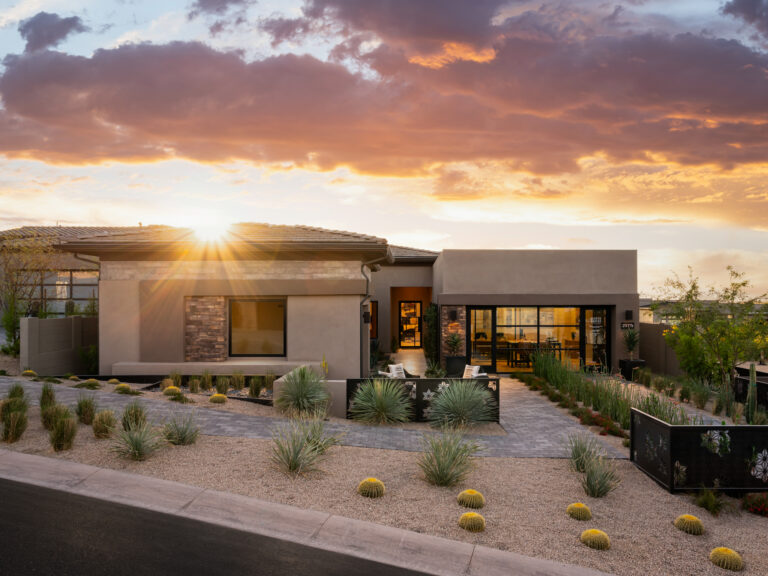
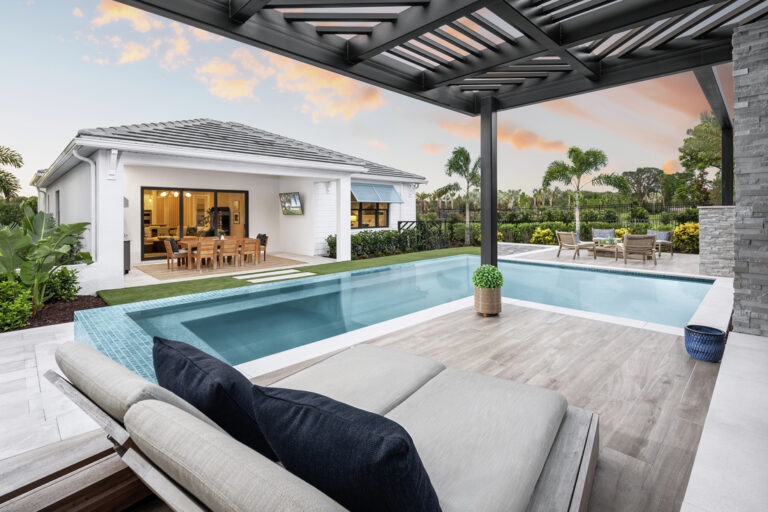
In luxury landscaping, a focal point decides far more than where people look. It can set the scale, the materials, the lighting plan and the mood for everything around it.
Get the anchor right and every other choice has something to answer to. Get it wrong, or skip it, and even expensive features start competing for attention.
The most common anchors fall into five families: water walls, fire bowls, sculptural plantings, custom metalwork and vanishing edge pools. Let’s walk through each one to see why it works, where it belongs and what to plan for before construction starts.
Why Every Luxury Landscaping Plan Starts With One Anchor
In a high-end yard, the focal point is the first design decision, not the last decoration.
Three ideas drive that thinking.
Hierarchy. One element leads. Everything else supports it. A yard can hold a pool, a kitchen, a fire lounge and a garden, but only one of them should claim the eye from the back door. Secondary features can still be beautiful. They just shouldn’t shout.
Sightlines. In the Valley, many homeowners see their backyard through glass for months at a time. So we tend to place the anchor where it lines up with the views that matter most: the great room slider, the kitchen sink, the primary suite, the front entry. If the focal point only looks good from the far corner of the lot, it isn’t doing its job.
Day and night. Arizona evenings are long and warm for much of the year. A strong anchor has a second life after sunset, through flame, uplighting or lit water. If it disappears at dusk, the yard loses its center for half the hours you’ll actually use it.
Water Walls: Movement You Can Hear Before You See
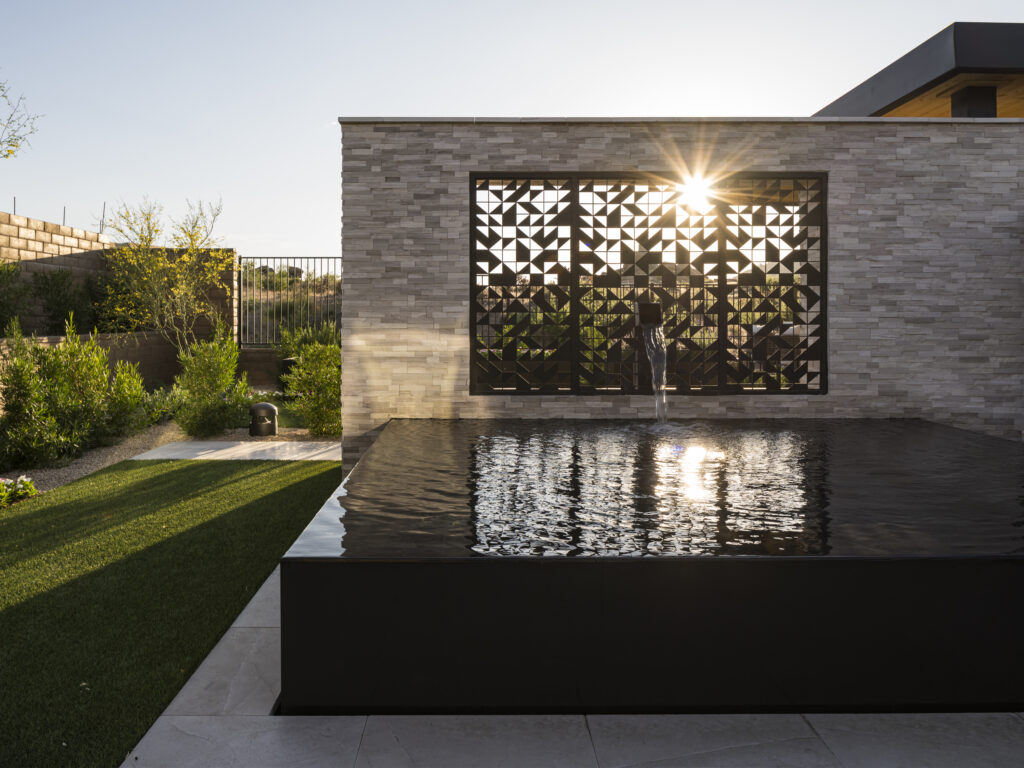
A water wall works because it engages two senses at once. The sheet of water catches light, and the sound masks traffic, pool equipment and neighbors. In a desert yard, that sound alone makes the space feel cooler.
Water walls suit tight lots especially well. They take up almost no floor area, so they anchor a side yard, a courtyard or the back wall of a pool without crowding the deck. On larger properties, they often terminate a long axis, giving the eye a clear end point.
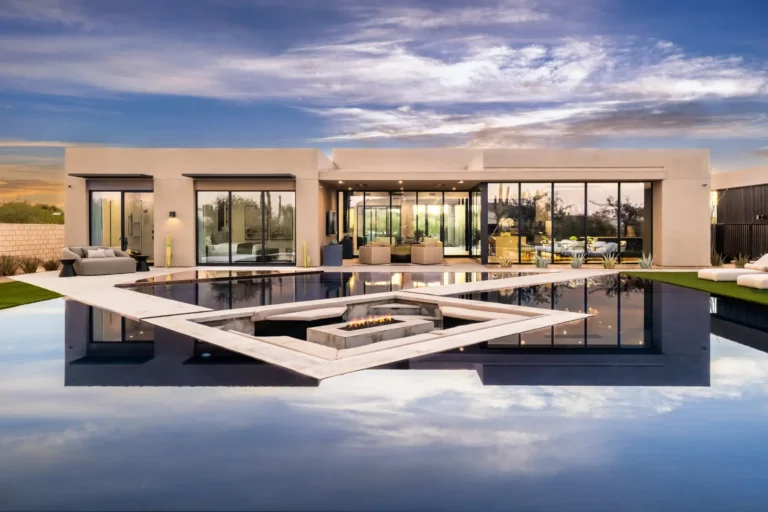
At The Stellan in Sereno Canyon, bespoke water features and scuppers bring movement and sound across a geometric pool. The falling water gives the pool its voice, and the planting and paving stay quiet so it can lead.
A few details separate a great water wall from an average one:
- Surface texture. Smooth stone or glass gives a clean, glassy sheet. Split-face stone breaks the water into a softer shimmer.
- Lighting. An LED channel at the base turns the wall into a lantern after dark.
- Splash control. Flow rate and basin depth need careful matching, or wind will carry water onto the deck.
Our fire and water features team handles the plumbing, stonework and automation in-house, so the finished wall looks the way it did in the 3D rendering.
Fire Bowls and Fire Features: The Anchor That Owns the Evening
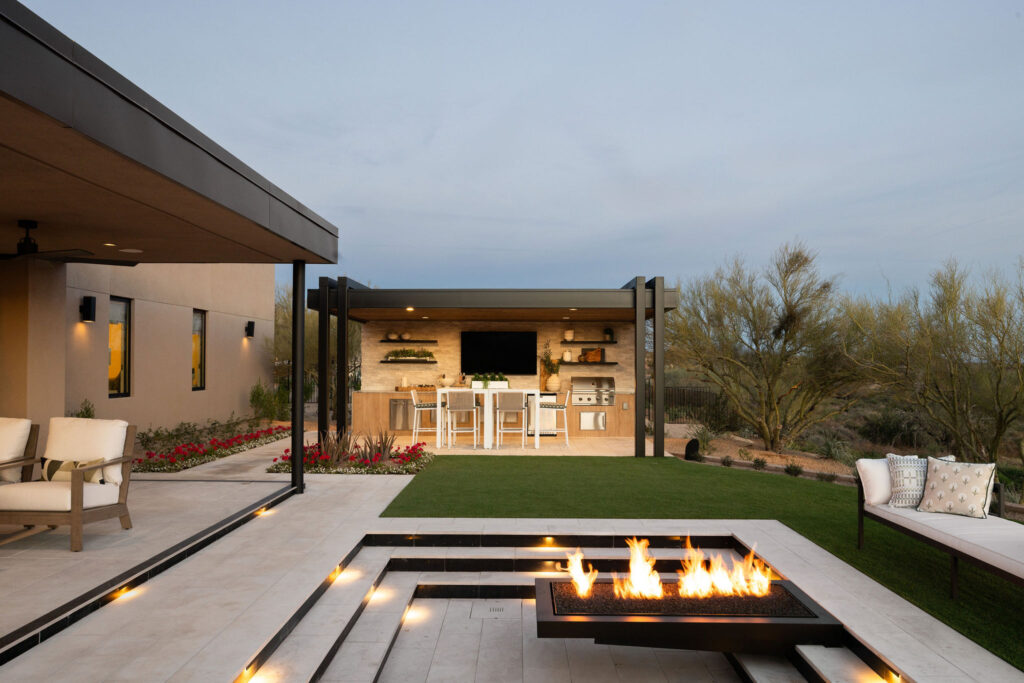
Fire is the one focal point that pulls people toward it. A water wall is something you look at. A fire bowl is something you gather around.
That makes fire the natural anchor for yards built around entertaining. It also solves an Arizona problem. From October through April, evenings cool off fast, and a fire feature keeps guests outside long after sunset.
At The Stellan, a dedicated fire retreat gives the yard a warm focal point for gathering after dark. Up in North Scottsdale, The Edge at Joy Ranch VI uses a cantilevered metal fire pit inside its fire lounge. The steel appears to float, which turns a practical feature into a piece of sculpture.
Fire bowls are a different tool. Set in pairs along a pool edge, they frame the water and give the deck rhythm. A single oversized bowl at the end of an axis does the opposite: it becomes the destination.
When fire is your anchor, plan these early:
- Gas line routing, before any paving goes down
- Seating distance, so the heat feels pleasant and not harsh
- Remote or app ignition, so the fire actually gets used
- How the flame reads from inside the house on a winter night
Sculptural Plantings and Specimen Trees: A Focal Point That Grows Into Its Role
Not every anchor needs a pump or a gas line. A single specimen tree can hold a yard together better than any built feature. It also gets better every year.
In the Sonoran Desert, the strongest candidates have bold structure. Think of a multi-trunk palo verde with its green bark, a gnarled olive, or a mature ironwood. Large agaves and columnar cacti work the same way at a smaller scale. What they share is silhouette. You can recognize them from fifty feet away, even at dusk.
The trick is to give a specimen room. Crowd it with other showy plants and it disappears. Surround it with low, quiet groundcover and decomposed granite, and it reads like art on a gallery wall.
Planting can also frame a focal point rather than be one. For Scottsdale Art Week, our team built a temporary entrance garden around a Gino Miles sculpture. Beds of seasonal annuals, raised metal planters and a water feature along the walkway all steered the eye to the piece. Nothing competed with it. That same thinking applies at home, whether the star is a sculpture, a boulder or a heritage tree.
Two practical notes:
- Uplighting. One or two well-aimed fixtures turn a tree into a night sculpture.
- Mature size. Plan for the canopy in ten years, not the box size on install day.
Custom Metalwork: Pattern, Shadow and Privacy in One Piece
Custom metalwork is the most underused focal point in luxury landscaping. Most homeowners picture a gate or a fence. In the right hands, steel becomes the artwork of the yard.
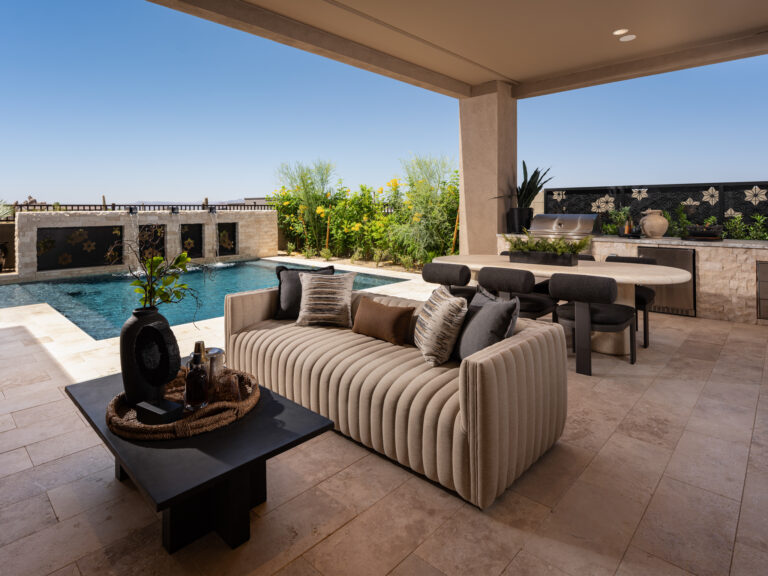
A laser-cut screen does two jobs. By day, it blocks a neighbor’s window and adds texture to a blank wall. In late afternoon, the sun pushes its pattern across the patio as moving shadow. After dark, a light behind the panel throws that pattern outward.
At Scottsdale’s The Shadow Ridge, intricate patterned metalwork gives the yard privacy and a distinct artistic layer that echoes the home’s architecture. At The Merion Grove in Queen Creek, metal planters and a slatted shade structure carry the home’s clean lines into the yard.
Creative Environments runs its own metal fabrication shop. That matters for focal pieces. Designers and fabricators work under one roof, so a pattern can be refined and checked before it ever reaches your yard. Corten steel, powder-coated aluminum and blackened steel each age differently in desert sun, so the finish deserves the same attention as the design.
If metal is your anchor, it’s recommended to keep the rest of the palette calm. One strong pattern reads as art. Three competing patterns read as noise. See more on our metal fabrication page.
Vanishing Edge Pools: When the Focal Point Is the View Itself
A vanishing edge pool is unusual among focal points. It draws the eye, then hands it off to something beyond the property line. The water appears to run straight into the mountains, the city lights or the open desert.
That only works with a view worth borrowing. On a flat lot facing a block wall, a vanishing edge has nothing to point at. On a hillside in North Scottsdale or Paradise Valley, it can become the defining image of the whole home.
The Edge at Joy Ranch V is a great example. Its curved infinity-edge pool uses perimeter overflow, so the surface reads like a mirror that stretches toward the desert horizon. A detached, raised spillover spa sits nearby as its own secondary focal point. It adds movement and sound without stealing the show.
That pairing indicates how hierarchy works in practice. The pool is the headline. The spa, the fire lounge and the layered desert planting are supporting cast, each placed so it never blocks the main sightline.
Vanishing edges demand more engineering than standard pools. You need a catch basin, careful grading and a structural plan for the downhill wall. That’s why we design and build ours in-house, from the first 3D model to final startup. Explore more options on our custom pools and spas page. 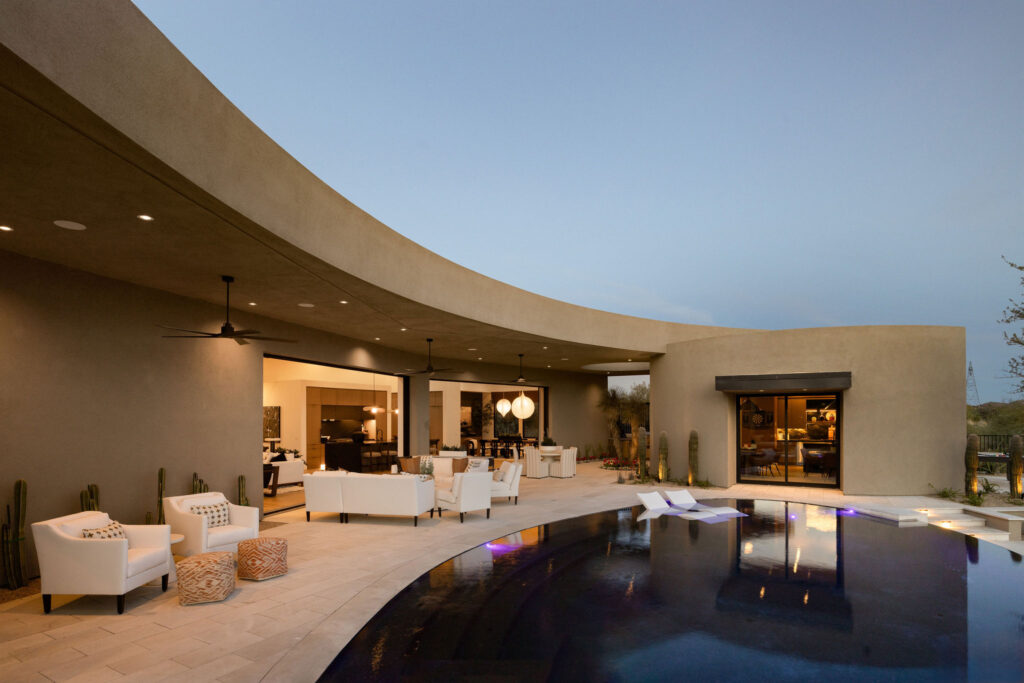
How to Choose the Right Focal Point for Your Property
The right anchor depends on your lot, your view and how you live outside. Start with these questions before you fall for a photo.
What do you see from inside? Stand at your main window or slider. Whatever sits in the center of that frame is your best focal point location.
Is there a view to borrow? If yes, a vanishing edge or a low, open design lets the horizon lead. If no, build the view yourself with a water wall, a specimen tree or a metal screen.
How do you use the yard? Entertainers usually want fire. Homeowners who want calm lean toward water. Collectors and art lovers often choose sculpture or metalwork.
How much room is there? Narrow side yards and courtyards favor vertical anchors like water walls and screens. Large lots can carry a vanishing edge pool or a grove around one hero tree.
What happens at night? Every focal point needs a lighting plan. If you can’t picture it after dark, the design isn’t finished.
Once the anchor is set, edit everything else. Pick one or two supporting elements and keep the rest simple. That restraint is what makes a luxury landscaping project feel calm instead of busy.
Find the Anchor Your Yard Has Been Missing
If your outdoor space feels unfinished, it may not need more features. It may need one clear lead.
For more than 75 years, Creative Environments has designed, built and maintained luxury landscaping projects across Arizona, all with one in-house team. Our designers can walk your property, find the sightlines that matter and show you the anchor in 3D before construction begins.
Browse our project gallery for more ideas, or book a design consultation to start planning yours.