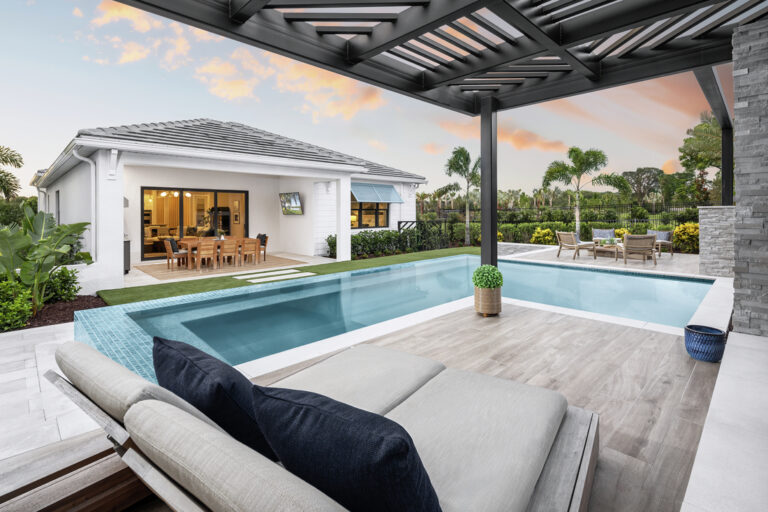
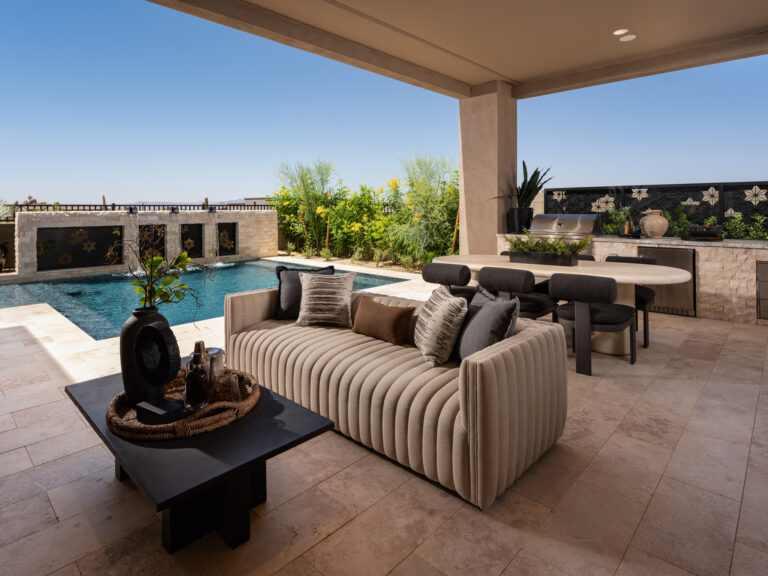
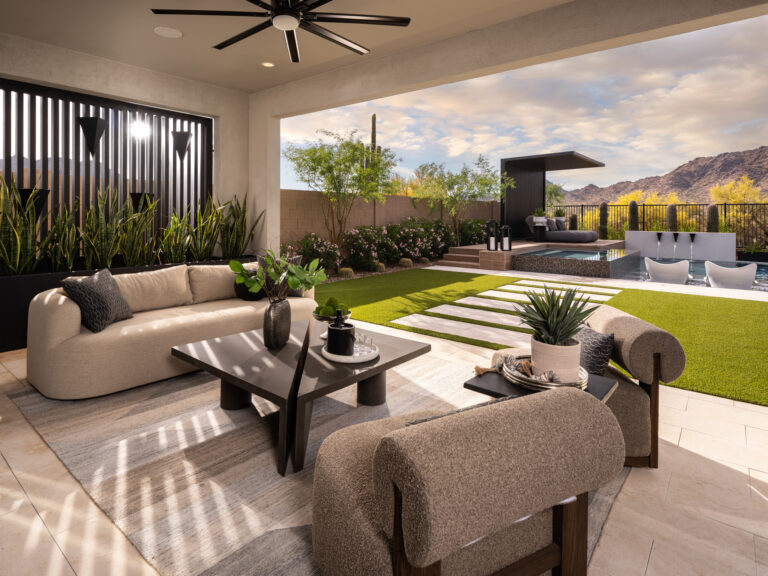
There’s a reason the outdoor kitchen has become the most-requested feature in luxury backyard design. In 2026, homeowners across the Phoenix metro aren’t just adding a grill and calling it a day. They’re commissioning fully equipped culinary spaces that rival their indoor kitchens in function, finish, and flow.
The question we hear most often from clients isn’t whether to build an outdoor kitchen. It’s how to organize an outdoor kitchen so it actually performs when you’re hosting 30 people on a Saturday night.
At Creative Environments, we’ve designed and built outdoor kitchen environments across Tempe, Scottsdale, Paradise Valley, and beyond for over 75 years. What separates a stunning outdoor kitchen from a frustrating one has almost nothing to do with the appliances.
It has everything to do with layout, workflow, and material intelligence.
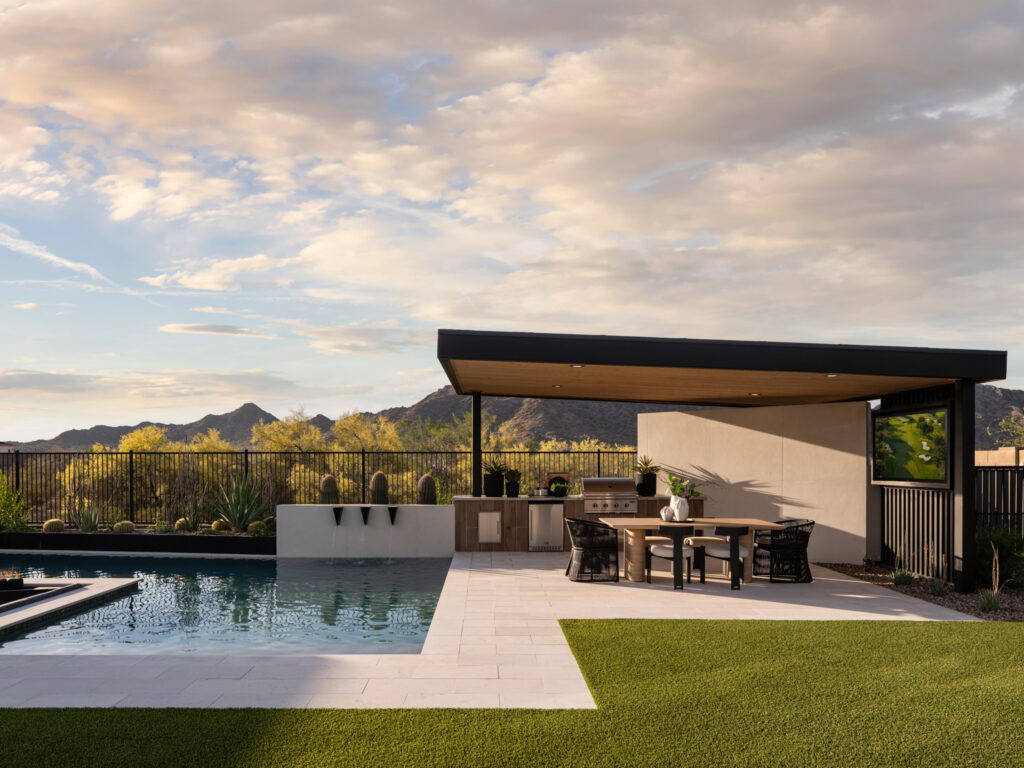
The 2026 Outdoor Kitchen Shift: Fewer Seams, More Continuity
Before we talk zones and materials, it’s worth understanding the design philosophy driving Arizona’s best outdoor kitchens this year. The prevailing trend is what designers are calling concealed utility: the idea that every mechanical, logistical, and functional element of the kitchen should be integrated into the architecture, not bolted onto it.
This means hidden refrigeration drawers instead of freestanding fridges. Flush-mounted sink covers that double as preparation surfaces. Utility access panels concealed behind matched stone cladding. Fewer materials used with greater consistency, so the eye travels fluidly across the space – rather than stopping at every seam and bracket.
The result is an outdoor kitchen that looks more like a room and less like a collection of outdoor appliances. That continuity isn’t just aesthetic. It simplifies cleaning, reduces maintenance, and makes the space feel intentional from every angle.
The Four Workflow Zones Every Outdoor Kitchen Needs
The single biggest mistake in outdoor kitchen design is treating the space as a linear counter with appliances. A kitchen that works, indoors or out, is organized around how people actually move through it.
At Creative Environments, we design every outdoor kitchen around four core workflow zones.
Zone 1: The Prep Station
The prep zone is where raw ingredients are washed, cut, and staged before cooking. It needs a deep, undermount sink (stainless or stone composite), generous counter surface, and easy access to refrigeration. In Arizona’s climate, proximity to shade matters here. Nobody wants to prepare vegetables in direct afternoon sun. We often position the prep zone under a pergola overhang or adjacent to a covered portion of the kitchen structure.
Storage matters as much as surface space. Deep drawers with custom dividers for cutting boards, knives, and tools are far more functional than a bank of cabinet doors. When everything is within arm’s reach and properly organized, the prep zone becomes the quiet command center of the whole kitchen.
Zone 2: The Cook Station
The cook zone is the performance heart of the outdoor kitchen.
In 2026, this means more than just a built-in gas grill. Creative Environments projects frequently incorporate a primary grill, a dedicated side burner for sauces and sautés, a pizza oven or kamado smoker, and an integrated warming drawer.
The key design principle here is the cooking triangle: the grill, the prep surface, and the landing zone should form a tight, efficient triangle that minimizes steps and maximizes the cook’s ability to manage multiple things at once. The landing zone on either side of the grill is critical: you need 18 to 24 inches of heat-tolerant counter surface on each side for safe plating and staging.
Ventilation and clearance are non-negotiable. Built-in grills need proper clearance from combustible surfaces, and in covered kitchen environments, a professional-grade exhaust hood is essential. This is one area where working with a licensed design-build firm like Creative Environments, rather than a general contractor, pays dividends. Our in-house team specifies, integrates, and inspects every element of the cook station.
Zone 3: The Bartend Station
The most social zone in any outdoor kitchen is the bar.
A dedicated bartending station, with a built-in beverage refrigerator, ice maker, wine storage, cocktail prep surface, and overhead glass storage, transforms your outdoor kitchen into a genuine entertainment hub.
Orientation matters enormously here. The bar should face the gathering space, not the cook station. When guests are seated at the bar, they should be watching the action: the cook at the grill, the fire table beyond, the pool in the distance. Not a wall or a fence. The best outdoor bars we build at Creative Environments create a natural semi-circle of energy, with guests on one side and the host on the other, everyone in easy conversation.
In Arizona, the bar also serves a practical function: it keeps guests hydrated and in their seats rather than wandering into the cook zone. A well-stocked, beautiful bar is an act of hospitality design.
Zone 4: The Cleanup Station
The cleanup zone is often the most underplanned area in most outdoor kitchens.
It deserves as much thought as the cook station. This means a large primary sink, not a prep sink, but a full-size cleanup sink, combined with a drawer dishwasher, trash and recycling pullouts, and adequate counter space for stacking and sorting.
Positioning the cleanup zone at the end of the kitchen’s natural flow is essential. You want dirty dishes moving away from the cooking and serving areas, not back through them. At Creative Environments, we often create a slight visual separation between the cleanup zone and the rest of the kitchen using a material shift or a partial counter height change, so the mess of cleanup doesn’t intrude on the presentation of the space.
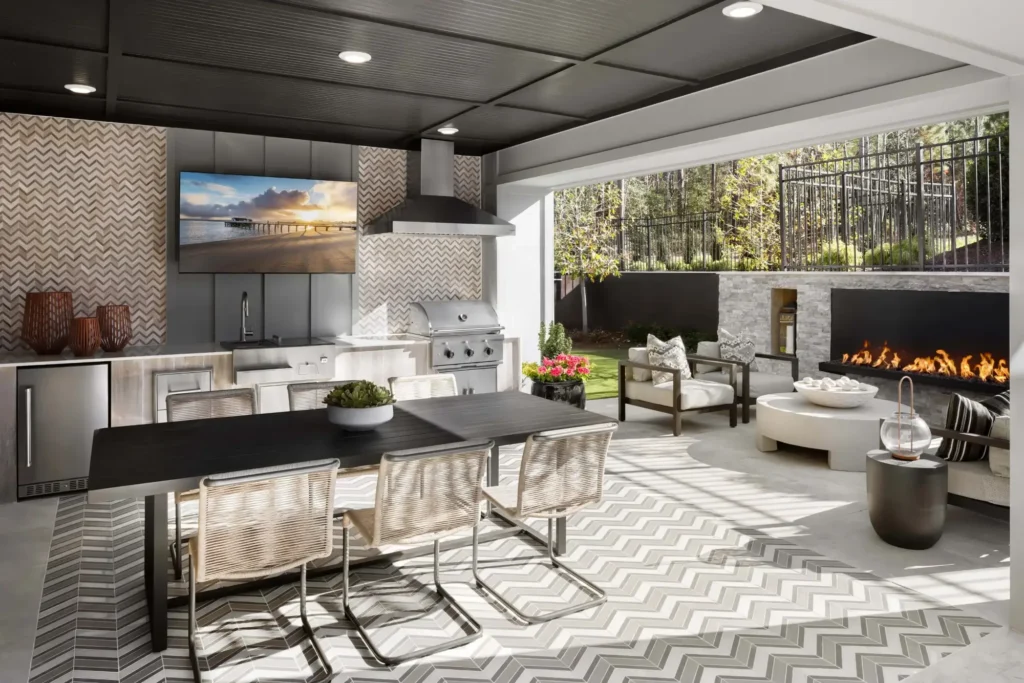
Material Recommendations for the Arizona Climate
Outdoor kitchens in the Phoenix metro face conditions that would destroy lesser materials within a season. Intense UV exposure, extreme heat fluctuations, monsoon moisture, and wind-driven dust are all in the equation.
Here’s what we specify, and why.
Porcelain Countertops and Cladding
Large-format porcelain has become our go-to surface material for outdoor kitchens, and for good reason. It’s virtually impervious to UV fading, doesn’t absorb moisture, resists heat, and can be fabricated in continuous slabs that minimize grout lines and maximize the seamless, high-end aesthetic that defines today’s best outdoor kitchens.
Arizona’s sun will fade, bleach, and crack many natural stones within a few years. Porcelain holds its color and finish indefinitely. It’s also easier to maintain in a dusty, high-use environment, a critical consideration for homeowners who actually use their outdoor kitchens rather than simply admiring them.
Stainless Steel Appliances and Hardware
Marine-grade stainless (304-grade or higher) is the only appropriate choice for outdoor appliance integration in Arizona. It stands up to UV and monsoon humidity, cleans easily, and maintains a clean, professional aesthetic. Doors, drawer hardware, appliance trim, and sink basins should all be specified in matching stainless to maintain visual continuity.
One note: brushed stainless finishes show fingerprints less than polished, which matters in a working kitchen. In our outdoor kitchen projects, we typically specify brushed stainless for high-touch surfaces and reserve polished finishes for decorative elements, such as hood surrounds.
Natural Stone Accents
Travertine, quartzite, and locally sourced desert stone add warmth and texture to the hard surfaces of a well-designed outdoor kitchen. We often use natural stone as the primary cladding material for kitchen columns and base structures, with porcelain for the working countertops, getting the visual richness of stone without compromising on performance.
Sealed travertine has been a hallmark of Arizona outdoor living for decades, and it remains a beautiful choice for vertical surfaces and accent elements. The key is proper sealing on installation and re-sealing annually to protect against moisture infiltration.
What to Avoid
Materials that will show their age within a few seasons of Arizona sun can include:
- Painted or stucco-clad bases
- Wood-look tile in unsealed grout applications
- Laminate countertops
- Powder-coated steel that isn’t rated for outdoor UV exposure
The investment in proper materials at the outset is always more economical than early remediation.
Built-In vs. Modular: How Creative Environments Approaches Outdoor Kitchen Design
There are two schools of outdoor kitchen construction: modular (pre-fabricated frames assembled on-site) and fully built-in (masonry, steel, or concrete construction integrated into the landscape design). At Creative Environments, we build the latter.
Our outdoor kitchens are designed as architectural elements. They are part of the backyard, not added to it. The kitchen structure shares material DNA with the pool coping, the hardscape, and the home’s exterior. Electrical, gas, and plumbing runs are planned from the ground up, not retrofitted through existing structures. The result is a kitchen that looks like it was always meant to be there, because in our design process, it was.
This approach also allows us to incorporate features that modular systems can’t accommodate: custom metal hood surrounds fabricated in our in-house metal shop, continuous stone cladding wrapping from the kitchen base to an adjacent fire feature, integrated lighting that’s wired directly rather than plugged in.
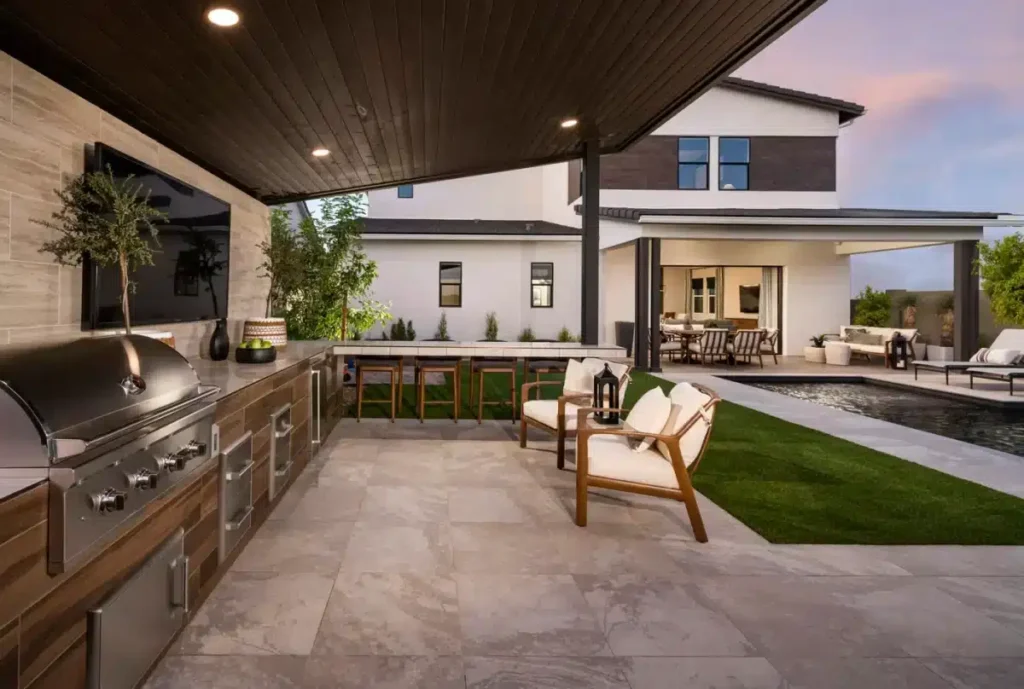
Designing for How You Actually Entertain
The best outdoor kitchen design starts with a single conversation: how do you entertain?
Some clients host large groups, 30, 50, even 100 guests for fundraisers, social gatherings or corporate events. Their kitchen needs maximum throughput, a wide serving counter, and a bartend station scaled for volume. Others entertain intimately, eight people around a table, with the host cooking as much a part of the evening as the meal itself. Their kitchen should create proximity, conversation, and theater.
Still others want a kitchen that works for Tuesday night family dinners as naturally as it does for Saturday night dinner parties. That’s where zone design, flexible counter space, and a well-placed bar stool matter most.
A jaw-dropping example of luxe outdoor kitchen design? The Parrish Residence.
At Creative Environments, we begin every outdoor kitchen project with a comprehensive discussion and planning session, not a product catalog. Understanding how you cook, who you host, and how you want to feel in your outdoor space is the foundation of every decision that follows.
Bringing It All Together: The Outdoor Kitchen as Lifestyle Investment
An outdoor kitchen isn’t a feature you add to a backyard. It’s a commitment to a way of living: to evenings outside, to meals that feel like occasions, to a home that draws people to the outdoors rather than keeping them inside.
When the layout is right, the zones flow intuitively, and the materials are chosen for the Arizona climate, the outdoor kitchen becomes the most-used room in your home. It becomes the place where conversations happen, where kids pull up bar stools, where guests linger after the last course because nobody wants to go inside.
That’s the outdoor kitchen we build at Creative Environments.
Ready to design an outdoor kitchen that actually works for your lifestyle?
Our team of award-winning designers is ready to transform your backyard into a fully equipped outdoor living environment. Contact us today for help getting started!
Creative Environments has been Arizona’s premier luxury outdoor design-build firm since 1950. Serving Tempe, Scottsdale, Paradise Valley, Phoenix, and the greater Phoenix metro area.