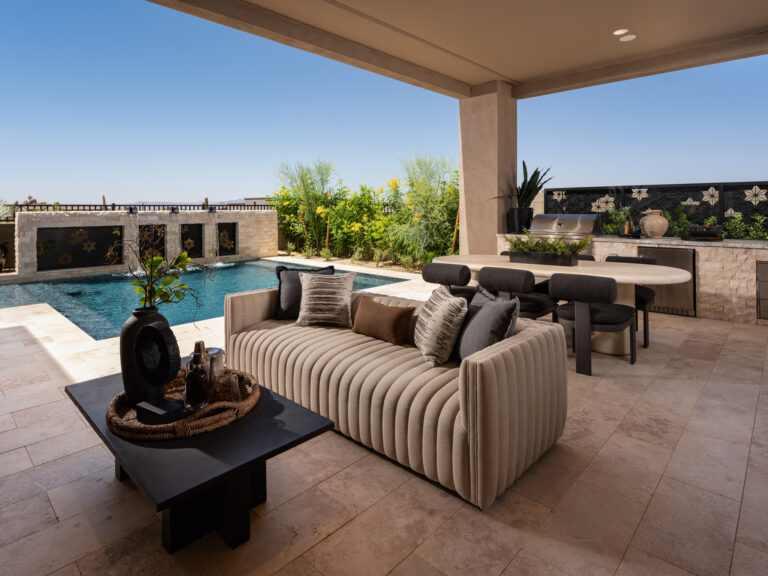
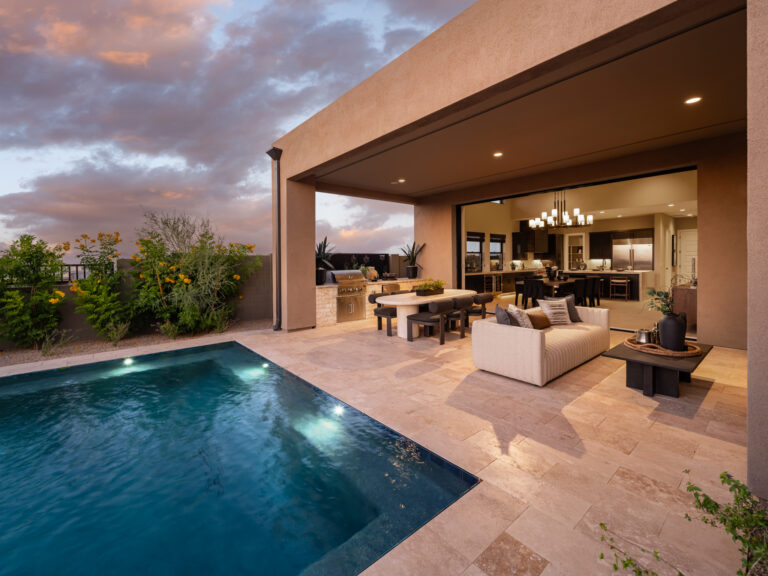
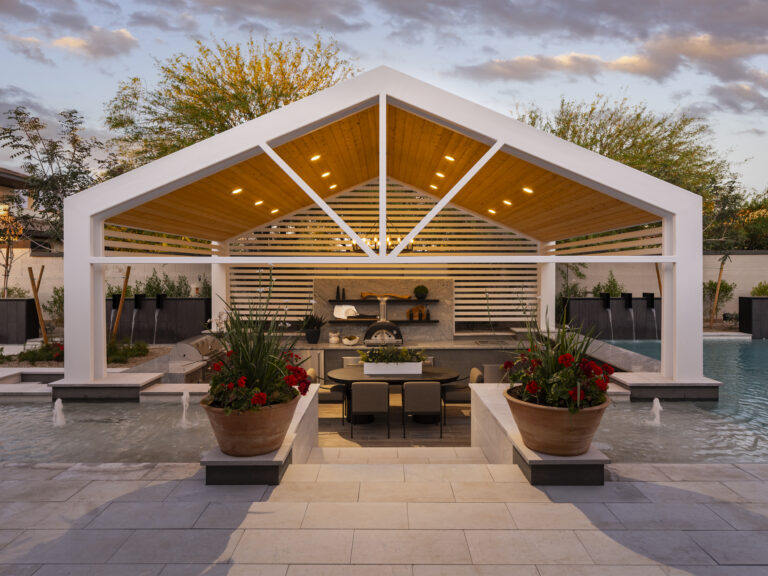
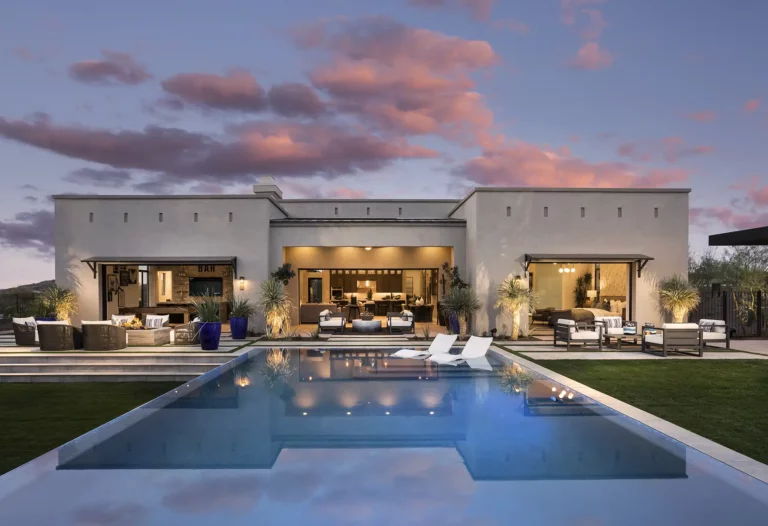
The alarm goes off at 5:45 a.m. By 6:00, a Phoenix homeowner is chest-deep in 48-degree water, breathing through a three-minute cold plunge. By 6:15, she is on a cushion in a shaded corner of the yard, olive trees overhead, a small stone bubbler running near her feet. By 6:45, she is back inside with coffee, already sharper than most people will feel all day.
Ten years ago, this routine required a boutique studio membership and a 20-minute drive. Today, it happens in the backyard.
Something significant is shifting in how Phoenix homeowners think about luxury outdoor living spaces. Backyards used to be built around entertaining. Weekend barbecues, birthday parties, the occasional pool day. In 2026, the fastest-growing category in luxury outdoor living is the private wellness retreat. Cold plunges. Hydrotherapy spas. Meditation gardens. Water features chosen for what they sound like, not just what they look like.
In this article, we cover the four pillars of the wellness backyard: cold plunge pools, spa design for daily hydrotherapy, meditation gardens, and acoustic water features. We also walk through how these elements come together on a real Phoenix lot, and why custom pools spas outperform prefab options for anyone serious about building a routine that lasts.
Why Phoenix Backyards Are Becoming Wellness Retreats
The shift did not start in the backyard. It started with how people spend money on their health. In recent years, at-home wellness spending overtook boutique gym and studio memberships for the first time. Recovery tools that used to live in professional facilities, ice baths, red light panels, contrast therapy circuits, are now standard features in many high-end homes.
Phoenix is uniquely positioned for this shift. More than 300 sun days a year. Mild winters. Low humidity. A homeowner in Minneapolis gets four months to use an outdoor cold plunge. A homeowner in Phoenix gets twelve.
The financial reframe matters too. A cold plunge, a spa, and a meditation garden are no longer being treated as recreational upgrades. They are being treated as health infrastructure. Daily use, measurable results, and a return that shows up in sleep quality, stress levels, and how buyers value the property when it eventually sells.
Search data backs this up. Phrases like “cold plunge installation Phoenix” and “backyard wellness design” have climbed sharply over the past 18 months. The demand is real, and it is local.
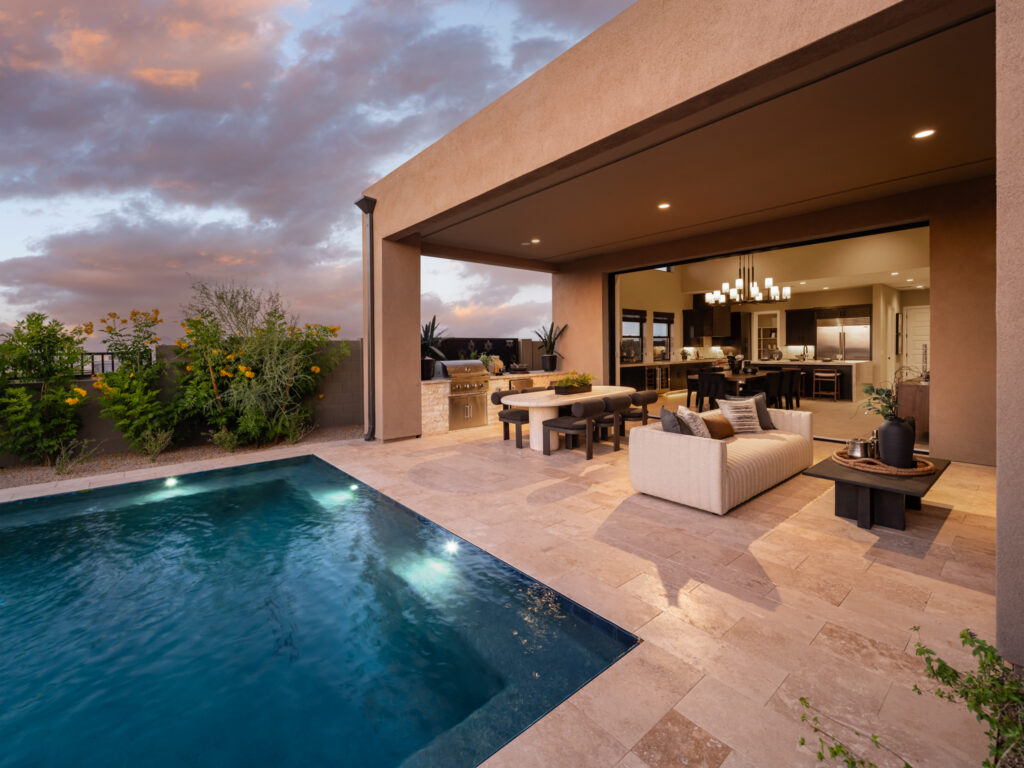
The Cold Plunge Pool: A Backyard Health Investment
What Cold Water Immersion Actually Does
Cold water immersion activates the vagus nerve, reduces systemic inflammation, and triggers a dopamine response that lasts hours after the plunge itself. Regular users report better sleep, sharper focus, and improved stress tolerance.
The point for a homeowner is simpler: those who engage in cold water immersion every day often feel different than the people who do not.
Design Considerations for a Phoenix Cold Plunge
Building a cold plunge in Phoenix is not the same as building one in Denver or Portland. The chiller has to fight ambient air temperatures north of 110 degrees for months at a time. That means an oversized unit, an insulated shell, and smart placement.
Shade is not optional. A cold plunge in direct afternoon sun forces the chiller to run constantly and drives energy costs up. Placement under a pergola, ramada, or dense tree canopy makes the difference between a system that runs efficiently and one that struggles.
Depth matters too. A real cold plunge allows full-body immersion up to the neck. That usually means a minimum of four feet of water depth and enough length for the user to fully extend. A short soaking tub is not the same experience.
Finally, the water itself. Phoenix water is hard, and calcium buildup can shorten equipment life. Interior finishes and filtration have to account for local water chemistry from day one.
Integrating a Cold Plunge with an Existing Pool
The strongest wellness backyards use contrast therapy. Hot spa, warm pool, cold plunge, all within a few steps of each other. Moving between temperatures can trigger a stronger physiological response than any one modality alone.
The best installations share equipment pads and automation, so the entire circuit can be managed from a remote device or app. And aesthetically, the cold plunge should feel like part of the original design, not a piece of gear bolted onto the deck.
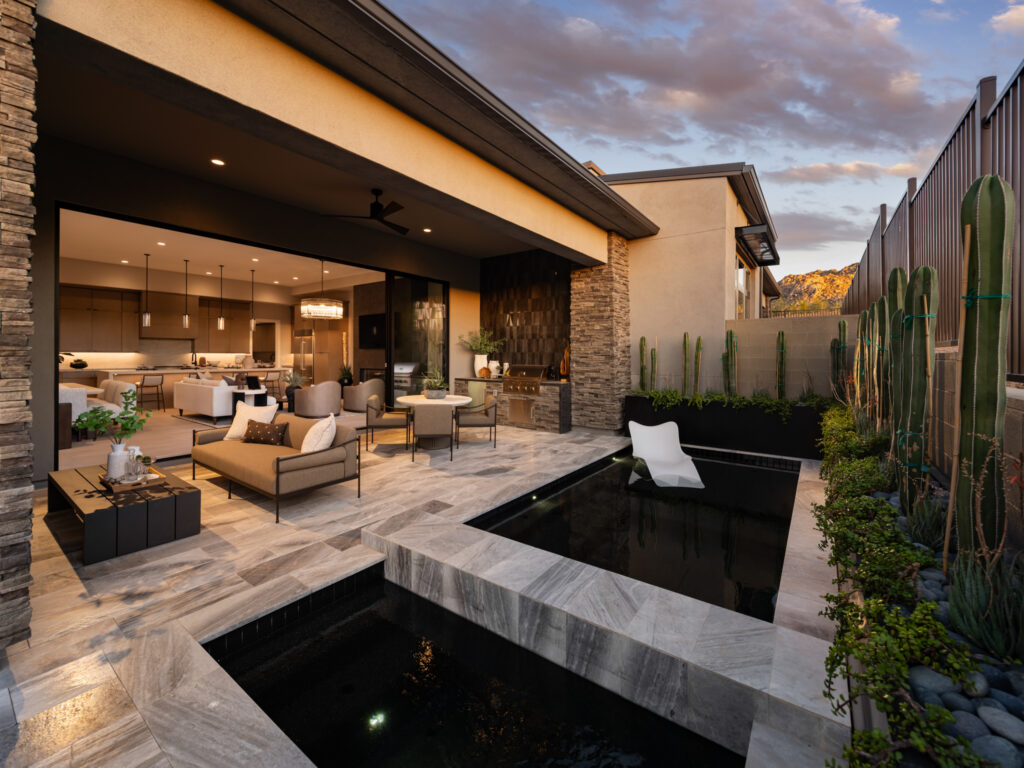
Modern Spa Design for Daily Hydrotherapy
Spa Design Has Moved Past Bubbles and Cup Holders
The spa of 2015 was built for parties. Six seats, dramatic lighting, jets pointed everywhere. The spa of 2026 is built for daily therapy. Deeper seats for full-body immersion. Jets configured for specific muscle groups. Temperature control precise enough to hold a target within a degree.
Custom pools and spas built into the pool deck now read as architecture. They share coping, finishes, and lines with the main pool. When done well, the spa becomes a feature of the overall design rather than an object dropped onto it.
Placement Matters as Much as the Spa Itself
Where the spa sits inside the yard determines how often it gets used. A spa positioned to catch morning sun becomes a wake-up ritual. A spa oriented toward the sunset becomes an evening wind-down. A spa facing the neighbor’s fence gets used a lot less than the brochure suggested.
Sightlines to a meditation garden, a fire feature, or a specimen tree turn a soak into something restorative. Sightlines to a pool pump or a garage door do the opposite.
Placement also has to support contrast therapy. The spa, the pool, and the cold plunge should form a short, dry-footed circuit, not a scavenger hunt across the yard.
Materials and Finishes for Phoenix
Natural stone coping in a light tone stays significantly cooler underfoot than dark porcelain. That matters when the deck hits 140 degrees in July.
Interior finishes should hide the fine desert dust that settles into everything between service visits. And lighting deserves real thought. LED systems that can tune to warm tones after sunset support the body’s circadian rhythm. Cool blue light at 9 p.m. tells the brain it is still midday, which is the opposite of what a wellness routine needs.
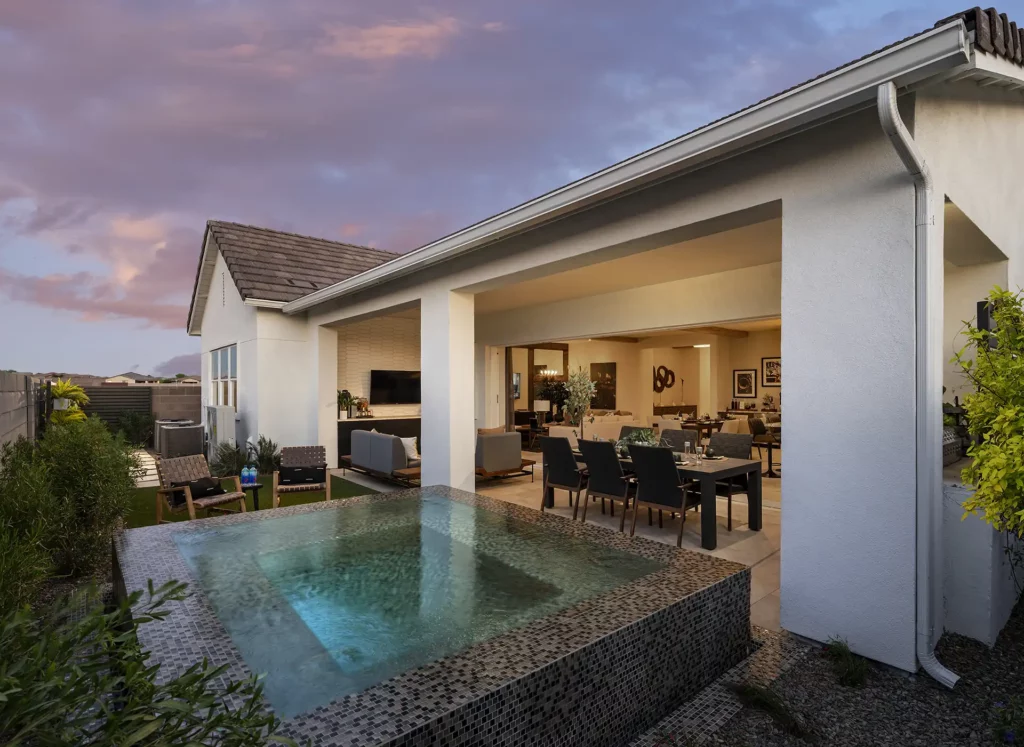
Meditation Gardens: The Quiet Center of the Wellness Backyard
What is a Meditation Garden?
A meditation garden is a defined, low-stimulation zone with intentional choices around plants, textures, and sound. These gardens often sit apart from the pool deck and any entertainment areas. They have their own boundary, floor, and atmosphere.
It is not a bench under a tree. It is a room without walls.
Design Principles
Enclosure is the first principle. Two or three sides should feel bounded, whether by low walls, screens, or dense planting. The fourth side stays open to a view or a focal point. A full enclosure can feel claustrophobic, while no enclosure at all feels more exposed.
The ground plane matters more than most homeowners realize. Decomposed granite has a soft crunch underfoot. Large stone slabs feel solid and grounding. Shaded turf pockets work for barefoot practice. Concrete does not belong here.
Every meditation garden needs one clear focal point. A weathered boulder. A single sculptural tree. A shallow water bowl. Too many focal points and the eye has nowhere to rest.
Plant Choices That Work in the Phoenix Climate
Olive trees, desert willow, and ironwood provide filtered shade without dropping heavy debris. Rosemary, lavender, and sage add scent zones that shift through the day. Ornamental grasses catch the wind and add subtle sound.
The plant palette should be restrained. Five or six species used repeatedly beats fifteen species scattered around. Restraint is the aesthetic.
Sensory Layering
A meditation garden works when it engages all four senses on purpose. Visual through plant form and focal points. Olfactory through aromatic herbs and blooming shrubs. Tactile through varied ground surfaces and hand-height plantings. Auditory through wind, water, and the absence of mechanical noise.
Miss one of the four, and the space may feel flat or incomplete.
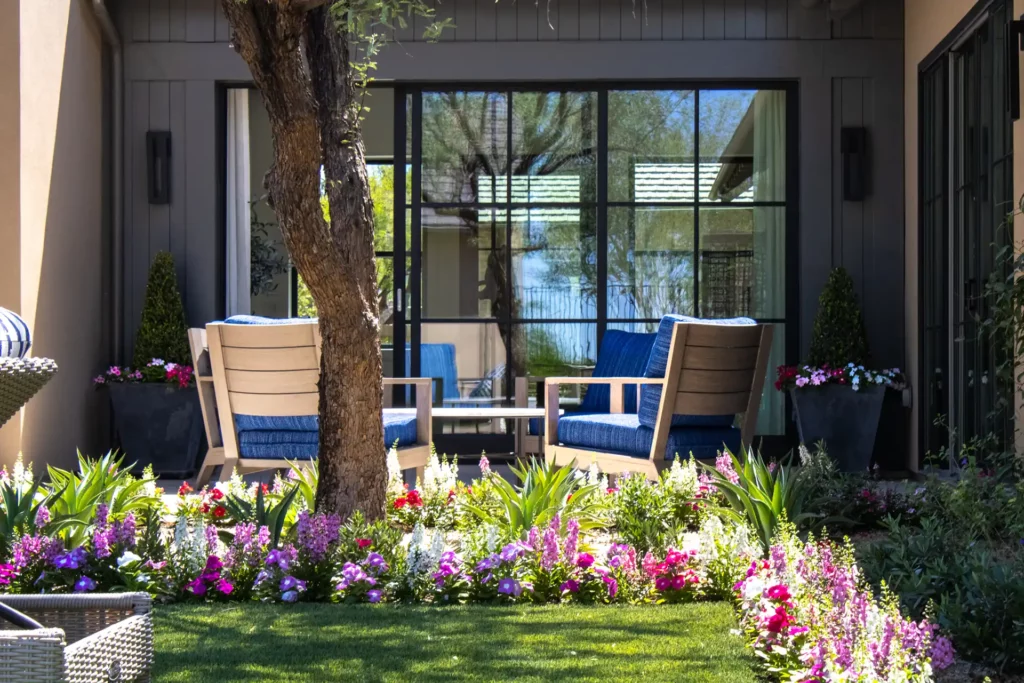
Acoustic Water Features and Mental Health
The Science of Water Sound
Moving water measurably reduces cortisol and masks the ambient noise of urban life. Freeway hum. HVAC units. A neighbor’s leaf blower. Water sound gives the nervous system a cue to downshift, and the body responds within minutes.
For anyone building a backyard around mental health, water sound is not decoration. It is a working design element.
Feature Types That Suit Wellness Zones
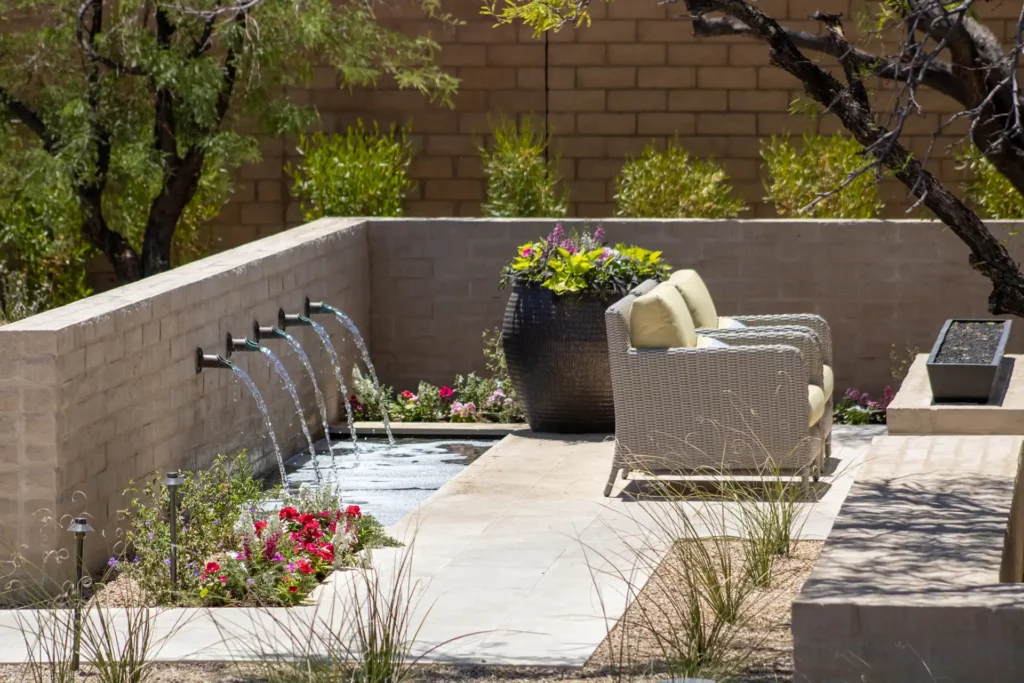
Wall-mounted sheer descents produce a steady, gentle white noise that pairs well with a spa. Boulder bubblers and pondless streams work inside meditation gardens because they produce sound without demanding attention. Perimeter runnels along a pool edge add a soft rush that carries across the whole yard.
Each feature has a personality. A tall waterfall sounds dramatic and busy. A small stone bubbler sounds contemplative. The feature should match the mood of the zone it serves.
Placement Rules
Louder features belong near the pool and social areas. Softer features belong near meditation zones and quiet corners. Every feature should sit far enough from bedroom windows that the homeowner can choose silence at night.
Multiple small water features usually outperform one loud centerpiece. Layered sound feels natural. A single loud feature can start to feel like a hotel lobby.
Zoning the Backyard for a Full Wellness Circuit
The best wellness backyards are designed around a daily flow. Wake up, cold plunge, meditation garden, back inside for work. Late afternoon walk through the garden. Evening spa. Dinner outdoors. Sleep.
That flow only works if the yard is zoned deliberately. Three to five zones with clear transitions and distinct sensory profiles. Each zone should be reachable without crossing another zone that carries a different mood.
A sample four-zone layout for a 10,000-square-foot Phoenix lot might include a wellness circuit with the pool, spa, and cold plunge on one side; a meditation garden tucked into a shaded corner on the opposite side; an entertainment zone with an outdoor kitchen and dining area at the center; and a shaded lounge with a fire feature between the entertainment area and the primary bedroom.
Privacy screening matters at every boundary. Planting, walls, or slatted screens keep each zone feeling enclosed even when the yard is shared with kids, guests, or neighbors. Lighting should be scene-controlled per zone so the wellness circuit stays dim in the evening while the entertainment area stays functional.
These are the relaxing backyard ideas that hold up over years of daily use, not just for the first weekend after installation.
Why Custom Pools and Spas Outperform Prefab in a Wellness Design
A wellness routine requires precision. The spa, cold plunge, and pool need to sit within steps of each other. Depths need to match the user’s body. Finishes need to align. Automation needs to run through one system, not three.
Prefab spas rarely deliver this. They arrive in fixed dimensions, with fixed jet layouts, and they almost never align cleanly with a custom pool deck. Homeowners end up with a wellness zone that looks and feels stitched together.
Custom pools and spas solve this. Shared automation. A single water treatment system across the pool and spa. Matched coping and finishes. Geometry that supports the actual routine the homeowner wants to build.
The long-term value case is real too. Buyers in the Phoenix and Scottsdale luxury market now ask about wellness features the same way they ask about kitchens. A wellness-integrated backyard is starting to influence appraisals and time-on-market in the high-end segment.
This is where a design-build model earns its keep. One team owns the pool, spa, plunge, hardscape, planting, shade structures, and lighting. Nothing gets lost in the handoff between three different contractors.
Bringing It All Together with Creative Environments
Creative Environments has been designing and building high-end backyards across the Phoenix and Scottsdale market for decades, and the wellness backyard is where the studio’s design-build model shows its full value.
The process starts with a discovery conversation about how the homeowner actually wants to use the space. Not just aesthetics, but routines. What time of day, which activities, which senses matter most. From there, the team moves into 3D design, then construction, then post-install support to make sure the wellness circuit performs the way it was designed to.
Our portfolio includes cold plunge integrations, custom pools and spas, meditation-focused landscape design, and acoustic water features tuned for the Phoenix climate. Every project is built to be used daily, not just admired from the kitchen window.
For homeowners ready to turn their backyard into a private wellness retreat, the next step is a consultation with the Creative Environments team.
The Future of Luxury Outdoor Living Spaces in Phoenix
The shift is clear. The best luxury outdoor living spaces in Phoenix are no longer being designed around weekend entertaining. They are being designed around daily health.
Wellness routines only stick when the environment supports them. A cold plunge in the wrong spot goes unused by February. A spa that does not connect to a quiet corner of the yard becomes a hot tub instead of a therapy tool. A meditation garden without a real enclosure becomes an unintentional patch of landscaping.
Done right, the wellness backyard removes the friction from the habit. The plunge is 20 steps from the bedroom. The spa is 10 steps from the plunge. The meditation garden is a short walk with a change of atmosphere at every step. The routine happens because the space makes it easy.
The backyards being designed in Phoenix in 2026 will shape home value and daily life for the next decade. For homeowners thinking about that horizon, the time to design the wellness retreat is now.